
A trinocular microscope can show a specimen through the eyepieces while sending a separate image to a computer, monitor, or recording system. That third optical path is useful for teaching, documentation, live viewing, and image analysis, but the camera itself must match the microscope’s port, optical layout, and intended use.
Some products in this category include a USB camera, while others provide only a camera-ready trinocular head. The distinction affects the total cost and setup time. Sensor resolution matters for saved images, but it does not automatically prove higher optical detail. Magnification numbers also need restraint, especially when a listing combines eyepiece, objective, and digital imaging claims.
The strongest options here are the camera-equipped SWIFT systems, particularly the SW350T with its analysis software and the SW380T with a 5MP camera. The Woehrsh, Poothoh, and SW320T provide lower-cost camera-equipped compound setups, while the DZQ and ZTEEERS systems serve different stereo inspection tasks with longer working distances and broader specimen access.
Quick Answer
- Best Overall: SWIFT Trinocular Compound Microscope SW350T for its included USB camera, Windows and Mac software, measurement tools, and compound optical configuration.
- Best High-Resolution Camera Package: SWIFT SW380T Trinocular Compound Microscope with 5MP Camera for its documented 5MP USB camera and imaging software.
- Best for Jewelry and Bench Inspection: DZQ Jewelry Trinocular Microscope with Camera for its 7X to 45X zoom, 95 to 300mm working distance, HDMI and USB operation, and ring light.
- Best Budget Camera-Ready Option: Swift SW380T Camera-Compatible Trinocular Microscope for buyers who already own or plan to choose a separate microscope camera.
Best Microscope Cameras for Trinocular Microscopes Comparison Table
| Product | Best For | Microscope Type | Camera or Connection | Advertised Magnification | Notable Feature |
|---|---|---|---|---|---|
| SWIFT SW350T | Computer-based imaging | Compound trinocular | 2.0MP USB camera | 40X to 2500X | Windows and Mac software with stitching, EDF, and measurement |
| SWIFT SW380T with 5MP Camera | Higher-resolution capture | Compound trinocular | 5MP USB camera | 40X to 2500X | Analysis software and camera port |
| SWIFT SW320T | Budget camera package | Compound trinocular | 2.0MP USB camera and C-mount adapter | 40X to 5000X advertised | Carrying case and 20:80 light split |
| Woehrsh Trinocular Microscope | Included accessories | Compound trinocular | HD USB camera and electronic eyepiece | 40X to 5000X advertised | Wide-field eyepieces and laboratory accessory kit |
| Poothoh Trinocular Microscope | USB classroom sharing | Compound trinocular | 1.3MP USB camera | 40X to 5000X advertised | Variable diaphragm and mechanical stage |
| DZQ Jewelry Trinocular Microscope | Jewelry and surface inspection | Stereo trinocular | 4K camera with HDMI and USB | 7X to 45X | 95 to 300mm working distance and 60-LED ring light |
| ZTEEERS Stereo Zoom Microscope | Flexible bench positioning | Stereo trinocular | Two camera adapter configurations | 3.5X to 90X | Boom stand and adjustable ring light |
| Swift SW380T | Separate-camera setups | Compound trinocular | Camera-ready third port | 40X to 2500X | Siedentopf head and fine focusing |
| PalliPartners Biological Microscope | Basic biological viewing | Compound trinocular | Camera-ready third port | 40X to 2000X | Top and bottom LED illumination |
The best match depends first on whether you need an included camera or a trinocular platform for a separate camera.
1. SWIFT Trinocular Compound Microscope SW350T — Best Overall

The SW350T is the most complete computer-based imaging package in this group. Its included 2.0MP USB camera is paired with software for Windows and Mac OS X, and the listing identifies stitching, Extended Depth of Field, and measurement functions. Those tools give the camera a more useful role in lab reports, classroom demonstrations, and specimen documentation than a camera that merely sends a basic live feed.
Its compound system uses 4X, 10X, 40X, and 100X oil achromatic objectives, with wide-field 10X and 25X eyepieces and a double-layer mechanical stage. The trinocular port allows simultaneous viewing through the eyepieces and digital imaging, while the Abbe condenser and coaxial fine focus support controlled slide work. The supplied information does not establish measurement accuracy or native sensor detail beyond the stated 2.0MP camera, so those software tools should be treated as workflow aids rather than proof of precision metrology.
Pros
- Includes a documented 2.0MP USB camera.
- Supports Windows and Mac OS X software.
- Provides stitching, EDF, and measurement functions in the supplied software description.
- Uses a dedicated trinocular port for simultaneous eyepiece viewing and imaging.
- Includes a mechanical stage, Abbe condenser, and 100X oil objective.
Cons
- The supplied information does not establish measurement accuracy.
- The camera is specified as 2.0MP, which gives less stated resolution than the 5MP SW380T package.
This is the best fit for buyers who want a ready-to-use compound imaging system with documented computer software. The SW380T with 5MP camera is a better match for buyers who place greater weight on the stated camera resolution.
To buy this product, click here.
2. SWIFT SW380T Trinocular Compound Microscope with 5MP Camera — Best High-Resolution Camera Package
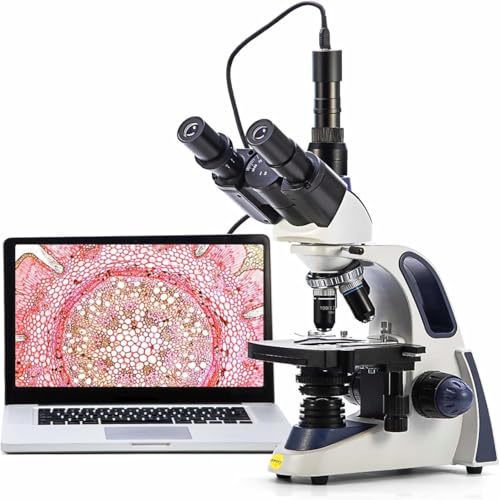
The SW380T pairs a 5MP USB camera with a compound trinocular microscope, making it the clearest choice for buyers who want the highest stated camera resolution among the compound systems listed here. The camera supports color photos and videos through supplied Windows and Mac software, which suits teaching images, specimen documentation, and digital sharing.
Its optical side includes 4X, 10X, 40X, and 100X oil achromatic objectives, WF10X and WF25X eyepieces, a mechanical stage, an NA 1.25 Abbe condenser, and an LED dimmer. Spring protection on the 40X and 100X objectives is a practical detail for slide handling. The 5MP figure describes the camera specification supplied in the listing, but it does not independently establish optical resolution, color accuracy, or low-light performance.
Pros
- Includes a stated 5MP USB camera.
- Provides Windows and Mac-compatible imaging software.
- Captures color photos and videos according to the product information.
- Includes 100X oil and 40X achromatic objectives.
- Offers an LED dimmer and NA 1.25 Abbe condenser.
Cons
- The supplied information does not identify sensor size or video frame rate.
- The package is centered on compound slide work rather than long-working-distance surface inspection.
Select this model for camera resolution and documented imaging software. The SW350T may be the better value for buyers who need similar compound features but do not prioritize the higher stated megapixel count.
To buy this product, click here.
3. SWIFT SW320T Trinocular Microscope with 2MP Camera — Best Budget Camera Package

The SW320T gives buyers a comparatively affordable way to add digital imaging to a compound microscope. It includes a 2.0MP USB camera, a C-mount adapter, and a stated 20:80 light split for simultaneous manual and digital observation. A carrying case, smartphone holder, slides, coverslips, immersion oil, and operating tools make the package useful for a school, home study area, or instructor who wants the basic pieces together.
The microscope uses 4X, 10X, 40X, and 100X oil objectives, a double-layer mechanical stage, coaxial coarse and fine focus, an adjustable 1W LED, and an NA 1.25 Abbe condenser. The listing advertises up to 5000X with a 2X Barlow lens, but that figure should not be treated as proof of equivalent optical resolution. Buyers focused on image analysis may prefer the SW350T because its supplied software description includes stitching, EDF, and measurement.
Pros
- Includes a 2.0MP USB camera.
- Provides a C-mount adapter for camera connection flexibility.
- Documents simultaneous manual and digital observation through a 20:80 light split.
- Includes a carrying case and smartphone holder.
- Uses a mechanical stage, Abbe condenser, and 100X oil objective.
Cons
- The supplied information does not identify the included software by name or its full feature set.
- The advertised 5000X maximum should not be read as a confirmed measure of optical resolution.
This package suits students and hobbyists who want a camera-equipped compound microscope with useful accessories at a lower listed price. Choose the SW350T instead if computer analysis features are central to the workflow.
To buy this product, click here.
4. Woehrsh Trinocular Microscope 40X-5000X — Best Included Accessory Kit

This Woehrsh compound system includes an HD USB camera and electronic eyepiece, so the buyer does not need to source a camera before beginning basic digital observation. Its wide-field WF10X and WF25X eyepieces, 2X magnifying lenses, LED illumination, and dual coaxial focus controls create a broad package for slide viewing and shared demonstrations.
The double-layer stage and 306-degree rotating head help accommodate multiple viewers, while the listing identifies a substantial accessory set with slides, coverslips, prepared sections, Petri dishes, tweezers, droppers, and a phone holder. The advertised 40X to 5000X range is a manufacturer claim whose optical meaning is not fully explained in the supplied information. Buyers should focus more on the compound configuration, camera connection, stage, and focusing controls than on the headline maximum.
Pros
- Includes an HD USB camera and electronic eyepiece.
- Provides WF10X and WF25X wide-field eyepieces.
- Uses dual coaxial coarse and fine focusing.
- Includes a double-layer mechanical stage and LED illumination.
- Supplies slides, coverslips, sections, and observation tools.
Cons
- The supplied information does not identify the camera’s native megapixel count.
- The 5000X advertised maximum is not accompanied by a clear optical-resolution explanation.
Choose this model for a ready-made compound kit with many starter accessories and an included digital camera. The SW320T offers clearer camera specifications, while the SW350T provides more detailed software information.
To buy this product, click here.
5. Poothoh Trinocular Microscope — Best for USB Classroom Sharing
The Poothoh combines a compound trinocular microscope with a stated 1.3MP USB camera. The product information describes computer or projector viewing, live streaming, recording, and image capture, with Windows and Mac OS X identified as supported platforms. That makes it relevant for a classroom or shared viewing setup where several people need to see a magnified specimen on a larger screen.
Its four achromatic objectives are listed as 4X, 10X, 60X, and 100X, alongside LED bright-field illumination, a variable diaphragm, and a double-layer mechanical stage. The stage should help with controlled X-Y slide movement, while the diaphragm gives the user a way to regulate illumination. The lower stated camera resolution may matter for buyers who plan to create detailed still images, and the listing does not clarify software features beyond the general imaging workflow.
Pros
- Includes a stated 1.3MP USB camera.
- Identifies Windows and Mac OS X support.
- Supports computer or projector viewing, recording, and image capture according to the listing.
- Provides a variable diaphragm for illumination control.
- Includes a double-layer mechanical stage.
Cons
- The stated 1.3MP camera resolution is lower than the SWIFT 2MP and 5MP packages.
- The supplied information does not identify advanced image-analysis or measurement software.
This model fits shared classroom viewing and basic biological slide documentation. Buyers creating higher-detail image libraries should look toward the SW350T or SW380T camera packages.
To buy this product, click here.
6. DZQ Jewelry Trinocular Microscope with Camera — Best for Jewelry and Bench Inspection
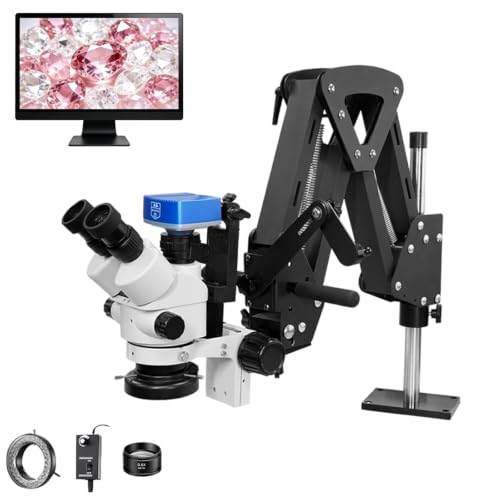
The DZQ is a different kind of trinocular camera system from the compound microscopes above. Its 7X to 45X continuous zoom, 95 to 300mm working distance, spring bracket, and mechanical focus are aimed at surface inspection where tools and fingers need room beneath the optics. Jewelry, watch parts, and other three-dimensional objects are a better match for this layout than prepared biological slides.
The included 4K camera supports HDMI and USB operation, with a mouse and flash drive connection described for standalone saving and control. A 60-LED ring light includes a dimmer from 0 to 100 percent, giving the user a way to reduce harsh illumination on reflective surfaces. The supplied information does not establish native sensor resolution, optical resolution, or whether every external display supports every camera mode, so the 4K label should be treated as an output claim rather than proof of equivalent optical detail.
Pros
- Includes a 4K camera system with HDMI and USB operation.
- Provides a documented 95 to 300mm working distance.
- Offers continuous 7X to 45X zoom.
- Includes a 60-LED ring light with dimming control.
- Provides a mechanical focus and spring-mounted inspection stand.
Cons
- This is a stereo inspection system rather than a compound biological microscope.
- The supplied information does not identify native sensor resolution or optical resolution.
Pick the DZQ for jewelry and general bench inspection where working clearance matters more than very high compound magnification. For prepared slides and cellular specimens, one of the SWIFT or Woehrsh compound systems is a more suitable direction.
To buy this product, click here.
7. ZTEEERS Professional Trinocular Stereo Zoom Microscope — Best for Flexible Positioning

The ZTEEERS system uses a stereo zoom optical arrangement with a 0.7X to 4.5X zoom objective, 0.5X and 2.0X auxiliary lenses, and a stated overall range of 3.5X to 90X. Its long single-arm boom stand is the major practical distinction. The arm provides a flexible mounting arrangement for larger objects, while the rectangular base and 360-degree rotation support shared viewing and repositioning.
The trinocular port includes two adapter configurations for electronic eyepieces and digital cameras, but a camera is not clearly identified as included in the supplied product information. A 56S LED ring light with dimmer is included, and the 45-degree viewing angle can suit extended inspection sessions. This system is better understood as a camera-ready stereo microscope than as a complete camera package.
Pros
- Provides a trinocular port with two documented adapter configurations.
- Offers continuous zoom through a 0.7X to 4.5X objective.
- Includes 0.5X and 2.0X auxiliary lenses.
- Uses a single-arm boom stand for flexible positioning.
- Includes a dimmable 56S LED ring light.
Cons
- The supplied information does not clearly identify an included digital camera.
- The stereo zoom design is aimed at surface inspection rather than compound slide microscopy.
This model is for buyers who already have a compatible camera or want adapter flexibility around jewelry, electronics, models, and other three-dimensional objects. The DZQ is a better fit for anyone who wants the camera and display workflow included.
To buy this product, click here.
8. Swift SW380T Camera-Compatible Trinocular Microscope — Best for Separate-Camera Setups

The SW380T is useful for buyers who want to choose their own microscope camera rather than accept an included imaging bundle. Its trinocular head accepts a camera attachment for viewing, live streaming, recording, and image capture, while the Siedentopf head rotates and supports interpupillary adjustment without losing focus according to the product information.
The compound optical system offers 4X, 10X, 40X, and 100X objectives, six listed magnification levels through the eyepieces, a mechanical stage, and coarse and fine focusing. The 30-degree head tilt is a practical ergonomic detail for longer slide-viewing sessions. Since the camera is not included, the final imaging experience depends on the separately selected camera, adapter, software, and computer compatibility.
Pros
- Provides a dedicated trinocular port for a separate camera attachment.
- Supports live streaming, recording, and image capture with a compatible camera.
- Includes 4X, 10X, 40X, and 100X achromatic objectives.
- Uses a Siedentopf head with a 30-degree tilt.
- Provides coarse and fine focusing controls.
Cons
- A microscope camera is not included in the supplied product description.
- The buyer must confirm camera, adapter, software, and computer compatibility separately.
This is the sensible pick for someone who already owns a preferred trinocular camera or wants to build a modular compound imaging setup. The SW350T or SW380T 5MP package is simpler for buyers who want the camera included.
To buy this product, click here.
9. PalliPartners 40x-2000x Biological Compound Trinocular Microscope — Best for Basic Biological Viewing

The PalliPartners model is a camera-ready compound microscope for buyers who want digital sharing alongside direct eyepiece observation. Its trinocular head allows a camera or other imaging device to be connected while users continue viewing through the eyepieces, which can be useful during classroom demonstrations or collaborative specimen work.
Top and bottom LED illumination gives the system flexibility for transparent and non-transparent specimens according to the listing, while the double-layer stage holds slides and the separate coarse and fine knobs divide rapid positioning from final focus adjustment. The listing does not identify a camera, sensor resolution, software package, or computer compatibility, so buyers should treat this as a microscope platform that requires a separately verified camera setup.
Pros
- Provides a trinocular port for a camera or additional imaging device.
- Offers separate coarse and fine focusing controls.
- Includes top and bottom LED illumination.
- Uses a double-layer stage for slide positioning.
- Lists a 40X to 2000X adjustable magnification range.
Cons
- The supplied information does not identify an included camera.
- Camera software and computer compatibility are not clearly specified.
This microscope suits buyers who already understand the camera requirements for a compound trinocular system and want a platform for basic biological observation. The SW320T is easier for beginners because its 2.0MP camera and software are included.
To buy this product, click here.
Buying Guide
Start With The Third Port
A trinocular microscope’s third port is the physical route for digital imaging, but the port alone does not tell you which camera will fit. The SW380T camera-ready model leaves the camera choice to the buyer, while the SW350T and SW320T include camera packages. Check whether the listing identifies a USB camera, C-mount adapter, electronic eyepiece, or another connection before comparing prices.
Separate Camera Resolution From Optical Detail
A 5MP camera can save more image data than a 2MP camera under suitable conditions, but megapixels do not automatically establish better optical resolution. The SW380T with 5MP camera is attractive for its stated specification, while the SW350T offers software functions that may matter more for documentation and analysis. Sensor size, frame rate, color accuracy, and native optical detail are not fully identified for every model here.
Choose Compound Or Stereo Optics
Compound systems such as the SW350T, SW320T, Woehrsh, and PalliPartners are built around prepared slides and transmitted illumination. Stereo systems such as the DZQ and ZTEEERS are better matched to three-dimensional surfaces, jewelry, components, and objects that need room beneath the optics. A high advertised magnification figure does not make a stereo inspection system equivalent to a compound biological microscope.
Check The Viewing Workflow
USB cameras generally send images to a computer, where software can provide recording or analysis features. The DZQ adds HDMI and USB operation, along with mouse and flash-drive control described for standalone use. The supplied information does not establish universal monitor compatibility, latency, or identical functions across every connection, so confirm those details before building a display-centered workflow.
Look At Working Distance For Surface Inspection
Working distance matters most when tools, fingers, or a larger object must sit beneath the microscope. The DZQ provides a documented 95 to 300mm range, making its intended inspection role clearer than the compound systems in this list. The ZTEEERS boom stand also supports flexible positioning, but its exact working-distance range is not specified in the supplied information.
Pay Attention To Lighting Control
Compound systems use features such as LED illumination, condensers, and diaphragms to manage slide viewing. The Poothoh identifies a variable diaphragm, while the SW350T and SW380T listings identify an Abbe condenser and LED control. For reflective jewelry or metal, the DZQ’s dimmable ring light may be more relevant, although no lighting arrangement eliminates every reflection.
Do Not Buy On Maximum Magnification Alone
Advertised magnification describes enlargement, not necessarily the ability to resolve finer detail. Several compound models list 5000X, while the SWIFT compound systems list 2500X and the PalliPartners lists 2000X. Those figures use different configurations and should not be treated as a direct performance ranking. Camera quality, objective design, illumination, focusing, and specimen preparation all affect the useful image.
Best Microscope Cameras for Trinocular Microscopes FAQ
Do All The Products Include A Microscope Camera?
No. The SW350T, SW380T with 5MP camera, SW320T, Woehrsh, Poothoh, and DZQ listings identify included camera hardware. The Swift SW380T and PalliPartners listings describe camera compatibility without clearly identifying an included camera. The ZTEEERS model describes camera adapter configurations but does not clearly identify a camera in the supplied information.
Is A 5MP Camera Automatically Better Than A 2MP Camera?
No. The 5MP figure indicates the stated camera resolution, but it does not establish optical resolution, color accuracy, low-light performance, or frame rate. A 2MP camera paired with better lighting, focusing, software, or optical alignment may still suit a particular documentation task better.
Can These Cameras Record Video?
The SW380T with 5MP camera, Poothoh, DZQ, and several other listings describe photo or video capture. The exact recording format, frame rate, file handling, and software workflow are not fully specified for every model, so buyers should verify those details for a particular project.
Can A USB Microscope Camera Work With Any Computer?
No. USB describes the connection, but operating-system support, drivers, software, and camera behavior still matter. The SW350T, SW380T with 5MP camera, Poothoh, and SW320T listings identify Windows and Mac support in their supplied information. Camera-ready models require separate compatibility checks for the chosen camera and software.
Are These Suitable For Biological Slides?
The compound models are intended for slide viewing and list objectives, condensers, stages, or biological applications. However, advertised magnification alone does not establish the ability to resolve bacteria, cells, or subcellular structures. Specimen preparation, objective quality, illumination, and optical resolution remain important.
Which Option Is Better For Jewelry Or Electronics Inspection?
The DZQ and ZTEEERS stereo systems are more relevant for three-dimensional surface inspection because they provide stereo viewing, zoom arrangements, and inspection-oriented mounting features. The DZQ gives the clearest documented working-distance information. Compound systems are better suited to prepared slides than to tool-access work around larger objects.
Does HDMI Mean The Camera Has No Noticeable Delay?
No. The DZQ listing identifies HDMI output, but it does not provide a latency measurement. HDMI can simplify connection to a compatible display, yet output behavior depends on the camera, display, and operating mode.
Can A Microscope Camera Authenticate Coins Or Gemstones?
A camera can document visible surface features, scratches, inclusions, or workmanship. It does not by itself establish coin authenticity, grading, gemstone identity, treatment history, or market value. Those conclusions require application-specific expertise and, in some cases, specialized instruments.
Final Verdict
The SWIFT SW350T is the strongest overall fit because it combines a dedicated trinocular imaging path, an included 2.0MP USB camera, Windows and Mac software, and documented stitching, EDF, and measurement functions. It gives buyers a clearer computer-imaging workflow than a camera-ready microscope that requires separate equipment.
The SW380T with 5MP camera is the better alternative for buyers who prioritize the highest stated camera resolution among the compound options. The SW320T offers a lower-cost included-camera package, while the DZQ is the more relevant choice for jewelry and surface inspection because its stereo design and documented working distance differ sharply from slide-focused compound systems.
