
A coin microscope has to reveal more than a dramatic close-up. Collectors usually need to read dates and mint marks, inspect scratches or possible errors, manage reflections on polished surfaces, and sometimes capture an image for a collection record. A tiny screen and a high advertised magnification number may look impressive, yet they do little if the coin is difficult to position or the lighting washes out its surface.
The strongest options here take different approaches. Some provide a larger built-in screen for shared viewing, some combine inspection with a built-in scale, and others are compact enough to carry to a coin show. Advertised magnification should be treated as an enlargement claim rather than a direct measure of optical resolution. Stand adjustment, field of view, lighting control, image capture, and the ability to view a whole coin often matter more during ordinary collecting.
For the broadest mix of coin inspection, weighing, documentation, and comfortable viewing, the TOMLOV DM4W Max is the most complete fit in this group. A smaller scale-equipped model may make more sense for a compact desk, while the TOMLOV DM9 or Elikliv seven-inch model suits collectors who prefer a larger viewing area. The right pick depends on whether your priority is localized error inspection, full-coin viewing, portability, or weight reference.
Quick Answer
- Best Overall: TOMLOV Coin Microscope with Weighing Scale, 7" Digital Magnifier DM4W Max for combining a 7-inch screen, full-coin viewing up to 32 mm, weighing, lighting, and image capture.
- Best for Large-Screen Inspection: TOMLOV DM9 7" Digital Coin Microscope 1200X, Soldering Scope for Adults for its 7-inch display, adjustable stand, flexible lighting, and included 16GB card.
- Best for Portable Inspection: TOMLOV P10 Microscope for Adults Kids, Handheld Coin Magnifier with Light for its lightweight handheld design, 2-inch screen, white and UV lights, and built-in photo memory.
- Best for Full-Coin Documentation: Elikliv 7" Full View Digital Coin Microscope with Weighing Scale and Lights for its stated full-coin view up to 38.2 mm and remote-controlled image capture.
Best Digital Microscopes for Coin Collecting Comparison Table
| Product | Best For | Display | Weighing | Image Capture | Standout Feature |
|---|---|---|---|---|---|
| TOMLOV DM4W Max | Overall coin inspection | 7-inch screen | 0.1 g, g/oz/ct/ozt | 16MP photos, 2K video | Full view up to 32 mm |
| TOMLOV DM9 | Large-screen detail work | 7-inch LCD | Not specified | 12MP photos, 1080P video | 16GB card included |
| Elikliv 7" Full View | Large coins and documentation | 7-inch screen | 0.1 g, g/oz/ct | 16MP photos, 1080P video | Full view up to 38.2 mm |
| Elikliv Coin Microscope with Scale | Compact weighing and inspection | 4.3-inch IPS | 0.1 g, up to 300 g | 12MP photos, 1080P video | 10 adjustable lights |
| TOMLOV DM4W | Desk-based weighing | 4.3-inch IPS | 0.1 g, g/oz/ct | USB viewing and recording | 8-inch stand |
| Elikliv EDM4C | Portable scale-equipped inspection | 4.3-inch IPS | 0.1 g, g/oz/ct | USB viewing and recording | Built-in battery |
| TOMLOV P10 | Handheld close-ups | 2-inch LCD | No scale listed | 16MP photos, 300-photo memory | White and UV lights |
| Aikokkl 4.3" LCD Microscope | Localized surface details | 4.3-inch LCD | No scale listed | Not clearly specified | Dimmable ring lighting |
| PalliPartners Digital Microscope | Longer portable sessions | 4.3-inch LCD | No scale listed | 32GB card included | Stated 4–5 hour battery life |
These nine models cover the main coin-collecting workflows, from close-up error inspection to full-coin viewing and weight reference.
1. TOMLOV Coin Microscope with Weighing Scale, 7" Digital Magnifier DM4W Max — Best Overall

The DM4W Max brings the parts of a coin-inspection setup that are often scattered across several tools into one device. Its 7-inch screen, built-in scale, LED lighting, and adjustable high stand support a hands-free workflow, while the product information identifies a full view for coins up to 32 mm. That makes it useful for checking a common coin’s date, lettering, edge, and mint area without constantly sliding the specimen beneath the lens.
Weight reference adds another practical layer. The scale offers 0.1 g resolution and displays grams, ounces, carats, or troy ounces, while the camera records 16MP photos and 2K video. Those figures describe the capture modes and scale readout, not independent proof of authentication or grading accuracy. A collector can document visible features and compare weight, but a microscope cannot establish whether a coin is genuine or whether a surface mark is a true mint error.
Pros
- Combines digital coin viewing with a built-in weighing scale.
- Shows many coins up to 32 mm in a full view, according to the product information.
- Includes a 7-inch screen for larger shared viewing.
- Supports 16MP photos and 2K video for collection records.
- Provides four weighing units, including grams and troy ounces.
Cons
- Larger coins may require repositioning for detailed inspection.
- The screen battery is listed for up to 1.5 hours, shorter than the base battery’s stated runtime.
This is the best fit for collectors who want one desktop system for visual inspection, weight reference, and documentation. Choose another model if a smaller footprint or longer screen runtime matters more than the seven-inch display and integrated scale.
To buy this product, click here.
2. TOMLOV DM9 7" Digital Coin Microscope 1200X, Soldering Scope for Adults — Best for Large-Screen Inspection

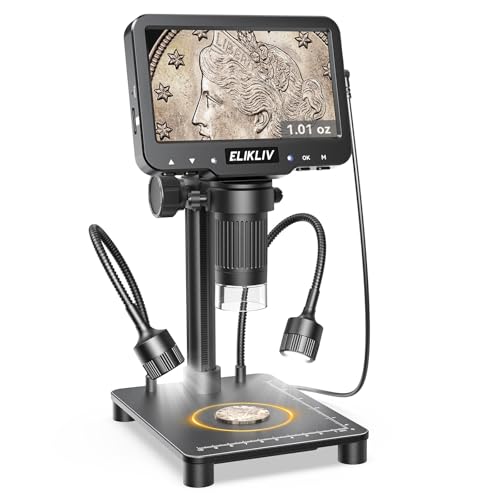
The DM9 is aimed at collectors who prefer to study coin details on a larger built-in screen rather than peer through a loupe. Its 7-inch LCD, adjustable 8.5-inch stand, and metal base create a hands-free setup for comparing dates, mint marks, scratches, and surface texture. The product information also describes two flexible gooseneck lights alongside eight built-in LEDs, giving users more ways to direct illumination across a reflective coin.
Image capture is well supported for cataloging. The camera is listed with 12MP photos and 1080P video, and a 16GB memory card is included. Its advertised 1200X figure should be treated as a magnification claim rather than a guarantee of extra optical resolution. The DM9 also lacks the built-in weighing function found on several alternatives here, so it suits visual inspection and records better than weight-based screening.
Pros
- Uses a 7-inch LCD for larger coin viewing.
- Includes an adjustable 8.5-inch stand and metal base.
- Offers eight built-in LEDs plus two flexible gooseneck lights.
- Captures 12MP photos and 1080P video.
- Includes a 16GB memory card for stored inspection records.
Cons
- Does not list a built-in weighing scale.
- The advertised 1200X magnification does not establish optical resolution by itself.
Pick the DM9 for a larger screen, flexible lighting, and included storage, especially if weighing is outside your routine. The DM4W Max is a better match for collectors who want weight readings beside visual inspection.
To buy this product, click here.
3. Elikliv 7" Full View Digital Coin Microscope with Weighing Scale and Lights — Best for Full-Coin Documentation

Collectors who frequently photograph entire coins will appreciate the emphasis on field of view. The Elikliv seven-inch model states that it can show a full coin up to 38.2 mm, including the design, lettering, and edges, with less repositioning. That is a meaningful distinction from a close-up microscope that may show a mint mark beautifully while cropping away most of the surrounding coin.
The built-in scale reads in grams, ounces, or carats with 0.1 g readability, and the system adds eight lens LEDs plus two side lights for reflective surfaces. A remote controls photos, video, and zoom, which can help avoid touching the display during documentation. The screen is listed for up to 1.5 hours of battery use, while the base is listed for up to three hours, so extended cataloging may require attention to power.
Pros
- Provides a stated full-coin view for specimens up to 38.2 mm.
- Combines visual inspection with 0.1 g weight readings.
- Uses a 7-inch screen for hands-free viewing and comparisons.
- Includes eight lens LEDs and two side lights.
- Supports 16MP photos, 1080P video, and remote operation.
Cons
- The screen’s stated battery runtime is up to 1.5 hours.
- Larger or highly detailed coins may still need repositioning for close inspection.
This model fits collectors who need full-coin records, larger-screen viewing, and weight checks in the same setup. The DM9 is preferable for flexible gooseneck lighting and included storage, while the DM4W Max offers a more compact full-view scale platform.
To buy this product, click here.
4. Elikliv Coin Microscope with Weighing Scale, Digital Magnifier 8+2 Lights — Best for Compact Weighing
This Elikliv combines a 4.3-inch IPS display with a scale that reads up to 300 g in grams, ounces, or carats. The arrangement suits a collector who sorts coins at a desk and wants visual details plus a quick weight reference without moving to a separate scale. Eight lens LEDs and two side lights address a common coin problem, since a direct ring light can create bright reflections across polished fields.
The camera records 12MP photos and 1080P video, and USB connection supports real-time viewing on a Windows or Mac computer. A Micro SD card is required for stored images and is not included. The built-in battery is listed for up to three hours, and the handheld section can detach from the stand, giving the device some flexibility outside a fixed desktop session.
Pros
- Measures items up to 300 g with 0.1 g resolution.
- Offers grams, ounces, and carats for different collecting tasks.
- Combines eight lens LEDs with two side lights.
- Captures 12MP photos and 1080P video.
- Supports Windows and Mac computer viewing through USB.
Cons
- A Micro SD card is required for storage and is not included.
- The 4.3-inch display is smaller than the seven-inch screens in the higher-ranked options.
This is a practical choice for collectors who want weighing and magnified inspection in a relatively compact package. Select the DM4W Max or Elikliv seven-inch model for full-coin viewing and a larger display, particularly with larger specimens.
To buy this product, click here.
5. TOMLOV DM4W Microscope with Weighing Scale: 4.3" Digital Coin Magnifier — Best for Desk-Based Weighing

The TOMLOV DM4W focuses on a compact desk setup with a 4.3-inch IPS display and an eight-inch stand. Its scale provides 0.1 g resolution and supports grams, ounces, and carats, while the supplied information identifies a stated accuracy of plus or minus 0.5 g. That makes the readout useful as a reference during sorting and comparison, though it should not be treated as proof of authenticity or professional grading.
The stand, enlarged base, and metal support rod are intended for a more fixed inspection arrangement than a handheld loupe. Adjustable LED lighting helps bring out dates, lettering, and surface wear, and USB output allows the view to reach a Windows or macOS computer. The built-in battery adds portability, although the published information does not give a specific runtime.
Pros
- Combines coin viewing with a 0.1 g weighing scale.
- Supports grams, ounces, and carats.
- Uses a 4.3-inch IPS display with a 178-degree viewing angle.
- Provides an eight-inch stand and enlarged base.
- Supports USB viewing on Windows and macOS computers.
Cons
- The 4.3-inch display provides less viewing area than the seven-inch alternatives.
- The published information does not identify a specific battery runtime.
Choose the DM4W if a compact, stand-mounted weighing microscope suits your collection routine. The Elikliv scale model offers a similar compact format with a stated three-hour runtime, while the larger TOMLOV DM4W Max is better for full-coin viewing.
To buy this product, click here.
6. Elikliv EDM4C Coin Microscope with Scale, 4.3" Weighing Digital Magnifier — Best for Portable Weighing

The EDM4C is another scale-equipped 4.3-inch microscope, but its listing places more emphasis on battery-powered portability. The device combines a 0.1 g scale with adjustable LED illumination, an eight-inch gear-driven metal stand, and a 4.3-inch IPS display. For a collector moving between storage shelves, a coin show, or a classroom demonstration, the built-in battery can reduce dependence on a nearby outlet.
USB connection supports larger-screen viewing, recording, and sharing on Windows or Mac computers. The product advertises a 2X–1000X range, though that range should be read as a manufacturer enlargement specification rather than a direct statement of optical resolution. Its practical strengths are the combination of weight reference, adjustable lighting, and a stand that provides more room beneath the camera than a small handheld loupe.
Pros
- Combines coin magnification with a 0.1 g scale.
- Supports grams, ounces, and carats.
- Includes an eight-inch gear-driven metal stand.
- Uses a 4.3-inch IPS display with a 178-degree viewing angle.
- Provides built-in battery power and USB computer connection.
Cons
- The 4.3-inch screen is smaller than the large-screen options.
- The advertised 2X–1000X range does not establish optical resolution by itself.
The EDM4C suits collectors who want scale functionality but may move the microscope around more often than a permanent desk setup allows. The TOMLOV DM4W is a comparable choice for a fixed station, while the seven-inch scale models better serve full-coin documentation.
To buy this product, click here.
7. TOMLOV P10 Microscope for Adults Kids, Handheld Coin Magnifier with Light — Best for Portable Inspection
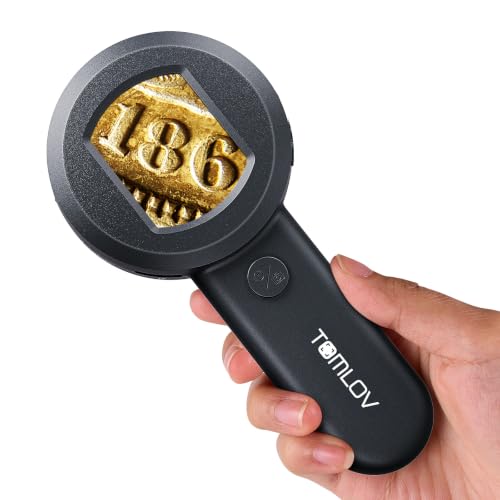
The P10 is the smallest and most mobile option in this roundup. It weighs 3.9 ounces, uses a two-inch LCD screen, and works at a fixed 100X magnification with 4X zoom. That setup is useful for quick checks at a coin show or for examining a localized feature such as a mint mark or edge detail, though it is less suited to viewing an entire coin at once.
Four white LEDs and four UV lights give the P10 a different lighting arrangement from the ring-lit stand models. The product information also lists 16MP photos and built-in memory for up to 300 photos, plus computer viewing through USB on Windows or Mac. Its stated runtime is up to 50 minutes, so this is a grab-and-check tool rather than a replacement for a long desktop cataloging session.
Pros
- Compact handheld design weighs 3.9 ounces.
- Includes a built-in two-inch LCD screen.
- Provides white and UV lighting options.
- Captures 16MP photos with storage for up to 300 photos.
- Supports larger-screen viewing through USB on Windows and Mac.
Cons
- Fixed 100X magnification limits framing flexibility.
- Stated battery runtime is up to 50 minutes.
This is the pick for collectors who value portability and quick localized inspection over a large viewing area. A stand-mounted 4.3-inch or seven-inch model is a better fit for sorting a tray of coins, comparing full designs, or creating longer cataloging sessions.
To buy this product, click here.
8. Aikokkl 4.3" LCD Digital Coin Microscope with LED Light — Best for Localized Surface Details
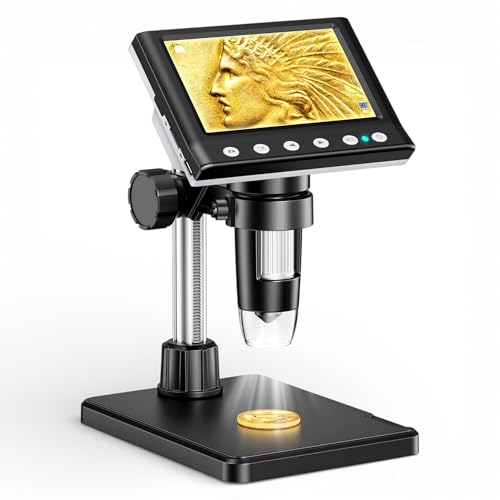
The Aikokkl is built around a compact standalone observation setup. Its 4.3-inch LCD avoids the need for a computer or external monitor during basic viewing, and the listing describes a 50X–1000X adjustment range with a rotary focus wheel. That combination is aimed at localized details such as dates, mint marks, and surface marks rather than full-coin composition.
Eight dimmable ring LEDs are presented as a way to manage reflections on glossy coins, polished watch parts, and jewelry. The weighted base and focus wheel support a fixed viewing position, although the product information does not identify a working-distance range, image sensor resolution, or storage system. Those omissions matter for collectors who want to build a detailed digital archive rather than simply inspect a coin on the screen.
Pros
- Includes a built-in 4.3-inch LCD for standalone viewing.
- Provides a stated 50X–1000X adjustment range.
- Uses eight dimmable LED ring lights.
- Includes a rotary focus wheel for distance adjustment.
- Uses a weighted base for hands-free observation.
Cons
- The published information does not clearly identify image storage or recording capability.
- The listing does not specify a working-distance range or native sensor resolution.
Consider the Aikokkl for a simple desk microscope focused on localized coin features and adjustable lighting. The P10 is easier to carry, while the DM9 and other seven-inch models provide more room for comparisons and shared viewing.
To buy this product, click here.
9. PalliPartners Digital Microscope for Coins with Light HD Screen — Best for Extended Portable Sessions

The PalliPartners model offers a familiar 4.3-inch LCD format with a metal bracket, adjustable focus, and eight adjustable LEDs. Its stated 50X–1000X range provides flexibility for moving between broader surface viewing and smaller details, though the number describes advertised enlargement rather than independently verified optical resolution. A collector can view coins directly on the screen and use the bracket for hands-free positioning.
Its clearest distinction is the supplied 32GB microSD card and a listed battery runtime of four to five hours. Those details make it appealing for collectors who want to save images and spend longer periods sorting or documenting pieces without the shorter runtime listed for the handheld P10. The product information identifies a 2MP camera and 1080P or 720P resolution, but it does not describe a weighing scale or computer operating-system compatibility.
Pros
- Includes a 4.3-inch LCD screen for direct viewing.
- Provides a 50X–1000X advertised magnification range.
- Includes eight adjustable LED lights.
- Comes with a 32GB microSD card for photos and video.
- Lists a built-in battery runtime of four to five hours.
Cons
- The product information does not identify a built-in weighing scale.
- The listing does not clearly establish Windows or macOS computer compatibility.
This model suits collectors who value included storage and the stated longer battery runtime in a compact stand-mounted design. Select the P10 for handheld portability, or choose a scale-equipped model if weight reference is part of your regular inspection process.
To buy this product, click here.
Buying Guide
Start With The Coin View You Actually Need
A close-up of a mint mark and a record of an entire coin are different imaging tasks. The P10 and Aikokkl focus on localized details, while the DM4W Max and Elikliv seven-inch model provide documented full-coin viewing for certain coin sizes. If you regularly compare whole designs, edges, and lettering, field of view deserves as much attention as the advertised magnification number.
For error hunting, a tighter view can be useful because it enlarges a small area for examination. A full-coin view is more convenient for cataloging and comparisons. Decide which task fills most of your collecting time before treating a large magnification claim as the deciding feature.
Treat Magnification Claims Carefully
Numbers such as 1000X and 1200X describe advertised enlargement, but they do not independently establish optical resolution. Digital enlargement can make an image appear larger without revealing additional surface information. A microscope with a useful stand, clear focus control, suitable lighting, and a workable field of view may produce a more useful inspection than a model with a larger number on its box.
The supplied products use different magnification descriptions, including fixed 100X, 50X–1000X, 2X–1000X, and 10X–200X. These ranges should not be compared as though they were standardized optical measurements.
Look For Lighting Control, Not Brightness Alone
Coins reflect light, especially proof surfaces and polished fields. A ring of LEDs can create a bright reflection directly over the detail you want to see, so brightness adjustment and light position matter. The DM9 adds flexible gooseneck lights, the seven-inch Elikliv model uses lens and side lights, and the P10 offers white and UV lighting.
Use lower brightness when highlights are washing out a date or mint mark, then change the angle of the coin or the light rather than simply turning the LEDs higher. A microscope listing can document the light arrangement, but it cannot guarantee that every reflective coin will be glare-free.
Choose A Stand That Matches Your Handling
A height-adjustable stand lets you change the camera-to-coin distance and reposition the specimen beneath the lens. That is helpful when moving between a broad surface view and a localized detail. Metal bases and enlarged stands appear on several models, while the P10 is intended for handheld use and the Aikokkl uses a weighted base.
Collectors who sort many coins benefit from hands-free positioning. Someone checking a single coin at a show may prefer the freedom of a handheld unit. Stand height should not be mistaken for working distance, and the available specifications do not provide exact working-distance measurements for most models.
Decide Whether A Scale Is Useful
A built-in scale can speed up sorting and provide a weight reference beside visual inspection. The scale-equipped models listed here provide 0.1 g readability or resolution, and some display grams, ounces, carats, or troy ounces. That information can support comparison with a coin’s expected weight, but it does not authenticate the piece by itself.
Scale-equipped microscopes also occupy more of the buying decision than a basic viewing model. If you already own a suitable scale, a larger-screen microscope such as the DM9 may devote more of its design to viewing and lighting. If you want one device for both tasks, the DM4W Max offers the broadest documented combination.
Plan Your Image-Storage Workflow
Image capture is useful for recording a possible error, comparing wear, or preparing a collection inventory. The products vary considerably. The DM9 includes a 16GB card, the PalliPartners model includes a 32GB card, and the P10 lists built-in memory for up to 300 photos. Several other models require a Micro SD card that is not included.
Capture resolution should not be confused with optical detail. A 16MP photo can provide a large file, yet the visible information still depends on the camera, lighting, focus, and optics. For routine documentation, stable positioning and controlled reflections may matter more than the largest stated photo figure.
Consider Computer And Battery Requirements
Several models support computer viewing through USB, including products that identify Windows and Mac compatibility. That can help with larger shared images, comparison work, or collection records. USB support should be read according to the supplied description, since a USB connection does not automatically establish every form of software control or compatibility.
Battery claims also vary. The P10 lists up to 50 minutes, the seven-inch Elikliv model lists up to 1.5 hours for its screen and up to three hours for its base, while the PalliPartners model lists four to five hours. A collector working at a fixed desk may care little about runtime, but a portable setup for shows or field use needs a closer look at the stated power figures.
Best Digital Microscopes for Coin Collecting FAQ
What Magnification Is Best For Coin Collecting?
There is no single useful number for every coin task. Lower enlargement can help frame a broad surface, while higher advertised enlargement can help inspect a mint mark or localized scratch. The supplied magnification figures are manufacturer claims and are not standardized optical-resolution measurements, so focus control, lighting, and field of view should guide the decision.
Can A Digital Microscope Authenticate A Coin?
No. A microscope can reveal visible lettering, surface marks, edge details, and possible anomalies. A built-in scale can provide a weight reference. Neither function independently establishes authenticity, grade, market value, or whether a surface feature is a genuine mint error.
Should I Choose A Microscope With A Built-In Scale?
Choose one if weight comparison is part of your normal workflow and you prefer one setup for viewing and weighing. The scale-equipped models listed here provide 0.1 g readings or resolution, but their measurements should be treated as useful reference data rather than a complete authentication process.
Is A Seven-Inch Screen Better For Coin Inspection?
A larger screen provides more viewing area for shared inspection and longer comparison sessions. It does not automatically prove better optical detail. A seven-inch model may also suit collectors who want to see more of a coin at once, while a compact 4.3-inch microscope can take up less desk space.
Do Adjustable LEDs Help With Shiny Coins?
They can provide more control over brightness and surface illumination. Reflective coins may still produce glare, so changing light intensity, light angle, camera position, and coin orientation remains useful. Models with side or flexible lights offer more documented lighting positions than a simple fixed ring arrangement.
Can These Microscopes Show An Entire Coin?
Some can, depending on the coin’s size and the selected viewing distance. The TOMLOV DM4W Max lists full viewing for coins up to 32 mm, and the Elikliv seven-inch scale model lists full viewing up to 38.2 mm. Larger specimens or close detail work may still require repositioning.
Do I Need A Computer To Use An LCD Coin Microscope?
A built-in LCD model can display the live image directly on its own screen. Computer connection is an additional feature on several products, useful for larger viewing, sharing, or file transfer. The exact computer functions and operating-system compatibility vary by model, so check the product-specific information rather than assuming every USB connection works the same way.
Can A Coin Microscope Replace A Loupe?
It can replace some loupe tasks, especially if you want a hands-free view, stored images, or a larger shared display. A handheld model such as the P10 is closer to a portable inspection aid, while stand-mounted models are better for stable documentation. Neither format removes the need for careful lighting and numismatic judgment.
Final Verdict
The TOMLOV DM4W Max is the strongest overall fit because it brings together a seven-inch screen, a stated full-coin view up to 32 mm, adjustable lighting, image capture, and a 0.1 g scale with several weighing units. Those features address the main coin-collecting tasks in one arrangement, while the documented limitations around larger coins and screen runtime remain clear.
Collectors focused on a larger display and flexible lighting should look at the TOMLOV DM9. The Elikliv seven-inch model is more attractive for full-coin documentation up to its stated 38.2 mm size, while the P10 favors quick portable checks. For a compact desk setup with weight reference, the 4.3-inch scale-equipped models offer a practical alternative, and the PalliPartners microscope suits longer sessions where included storage and stated battery runtime matter.
