
A doubled mint mark can sit in a tiny patch of raised metal, while a scratch can mimic the same shape under harsh light. That is why coin error inspection calls for more than a large magnification number. A useful setup needs controlled illumination, a focus adjustment that holds the detail steady, and enough viewing area to move from a full coin to a suspicious date, mint mark, or rim feature without losing context.
Advertised magnification deserves a cautious reading. Numbers such as 1,000X or 1,200X describe enlargement, but they do not by themselves establish optical resolution or prove that a microscope will reveal a genuine mint error. Field of view matters too. A compact 4.3-inch microscope may be excellent for examining a localized mark, while a larger screen and taller stand can make coin comparisons less cramped. Storage, computer output, lighting angles, and whether a memory card is included also shape the inspection workflow.
The strongest options here divide into a few practical groups. The TOMLOV DM9 offers a large display, adjustable stand, multiple lights, and included storage for a well-rounded bench setup. The Elikliv full-view model is more useful for seeing larger coins with less repositioning, while the Aikokkl models focus on close-up surface work and directional lighting. A scale-equipped TOMLOV model adds weight readings beside visual inspection, although neither magnification nor weight alone proves authenticity or confirms a numismatic error.
Quick Answer
- Best Overall: TOMLOV DM9 7" Digital Coin Microscope 1200X, Soldering Scope for Adults | Metal Base, Ultra-Precise Focus, 12MP Photo/1080P Video, 10 LEDs, Error Coin View, PCB Repair, for Collectors, PC View, 16GB for its 7-inch screen, adjustable stand, multi-angle lighting, image capture, and included 16GB card.
- Best for Full-Coin Viewing: Elikliv 7" Full View Digital Coin Microscope with Weighing Scale and Lights for its documented full-coin view up to 38.2 mm and 7-inch display.
- Best for Portable Close-Ups: TOMLOV P10 Microscope for Adults Kids, Handheld Coin Magnifier with Light for its 3.9-ounce handheld design, built-in memory, and short-session portability.
- Best for Directional Lighting: Aikokkl 4.3" LCD Digital Coin Microscope with 2 Side Lights for its detachable side lamps, PC live view, and focus system aimed at localized coin details.
Best Digital Microscopes for Coin Error Inspection Comparison Table
| Product | Best For | Display | Lighting | Capture And Connection | Advertised Magnification |
|---|---|---|---|---|---|
| TOMLOV DM9 7" Digital Coin Microscope 1200X, Soldering Scope for Adults | Metal Base, Ultra-Precise Focus, 12MP Photo/1080P Video, 10 LEDs, Error Coin View, PCB Repair, for Collectors, PC View, 16GB | Overall coin error inspection | 7-inch LCD | 8 adjustable LEDs plus 2 gooseneck lights | 12MP photos, 1080P video, PC connection, 16GB card | Advertised up to 1200X |
| Elikliv 7" Full View Digital Coin Microscope with Weighing Scale and Lights | Full-coin viewing and weighing | 7-inch screen | 8 lens LEDs plus 2 side lights | 16MP photos, 1080P video, USB live view and file transfer | 5X digital zoom is specified |
| TOMLOV DM10 Digital Coin Microscope with Light, 10.1" Soldering Magnifier | Large-screen viewing and documentation | 10.1-inch IPS | 8 adjustable LEDs plus 2 gooseneck lights | Up to 16MP photos, 1080P video, USB output, included microSD card | Advertised 5X–1200X |
| TOMLOV DM4W Microscope with Weighing Scale: 4.3" Digital Coin Magnifier | Portable inspection with weighing | 4.3-inch IPS | Built-in LED lighting | USB output for Windows and macOS | Advertised 10X–200X |
| Aikokkl 4.3" LCD Digital Coin Microscope with 2 Side Lights | Localized error details and directional light | 4.3-inch LCD | 8 LEDs plus 2 detachable side lamps | 1080P video, 10MP photos, USB Type-C PC live view | Magnification range not clearly specified |
| Aikokkl 4.3" LCD Digital Coin Microscope with LED Light | Standalone close-up viewing | 4.3-inch LCD | 8 dimmable ring LEDs | Standalone viewing, charging cable included | Advertised 50X–1000X |
| Elikliv Microscope, Digital Coin Microscope 1000x with Lights, EDM4, 4.3" | 8 Adjustable LED Lighting, 720P LCD Microscope, Built-in Rechargeable Battery, Take Photos/Videos, Windows/MacBook Compatible | Value-focused coin and mint-mark inspection | 4.3-inch, 720P LCD | 8 adjustable LEDs | Photos and video, Windows and MacBook connection | Advertised up to 1000X |
| TOMLOV P10 Microscope for Adults Kids, Handheld Coin Magnifier with Light | Portable, quick close-ups | 2-inch LCD | 4 white LEDs plus 4 UV LEDs | 16MP photos, built-in memory, Windows and Mac connection | Fixed 100X with 4X zoom |
| Leipan 4.3" Coin Microscope Coin Magnifier, 1980P HD Digital Microscope | Basic LCD inspection and recording | 4.3-inch IPS | Not clearly specified | One-click photos and video | Advertised 50X–1000X |
Each microscope suits a different balance of close-up detail, coin coverage, lighting control, and documentation.
1. TOMLOV DM9 7" Digital Coin Microscope 1200X, Soldering Scope for Adults | Metal Base, Ultra-Precise Focus, 12MP Photo/1080P Video, 10 LEDs, Error Coin View, PCB Repair, for Collectors, PC View, 16GB — Best Overall

The DM9 has the broadest documented feature set for a collector who wants to inspect a suspicious mark, save a record, and show the view to someone else. Its 7-inch LCD is larger than the 4.3-inch screens used by several alternatives, while the adjustable 8.5-inch metal stand allows the camera position to change with the subject. That combination is useful when one coin requires a tight look at a mint mark and the next needs a wider positioning setup.
Lighting is a meaningful part of the DM9’s appeal. Eight built-in LEDs provide direct illumination, and two flexible gooseneck lights can approach a coin from different angles. That arrangement gives the user more control over shadows and reflections than a single fixed ring light. The microscope also records 12MP photos and 1080P video, connects to a Windows or Mac computer for a larger live view, and includes a 16GB memory card, so inspection notes do not have to remain trapped on the screen.
Pros
- Uses a 7-inch LCD for larger direct viewing than the compact 4.3-inch models.
- Includes an adjustable 8.5-inch metal stand for changing camera height and viewing range.
- Combines eight built-in LEDs with two flexible gooseneck lights for varied illumination angles.
- Supports 12MP photos and 1080P video for collection records and close-up documentation.
- Includes a 16GB memory card and PC connection for storage and larger-screen viewing.
Cons
- The listing uses a 1200X magnification figure without establishing whether that figure is optical, digital, or display-based.
- The supplied information does not specify the exact working-distance range for tool access beneath the lens.
Collectors who want one bench microscope for error-coin detail, image records, demonstrations, and occasional electronics inspection have the clearest case for the DM9. A smaller handheld model is easier to carry, while the DM9 is better suited to a fixed inspection area where its larger display and adjustable lighting can be used fully.
To buy this product, click here.
2. Elikliv 7" Full View Digital Coin Microscope with Weighing Scale and Lights — Best for Full-Coin Viewing

This Elikliv model addresses a problem that many small coin microscopes leave unresolved: seeing enough of the coin to understand where a close-up feature sits. Its published full-coin view reaches up to 38.2 mm, and the 12.6-inch stand is described as giving a wider field of view. That makes it a particularly relevant option for larger pieces such as Morgan dollars, where a compact screen may show only a section at a time.
The built-in scale adds a second inspection reference. The unit displays weight in grams, ounces, or carats, with 0.1 g readability across a stated 0 to 300 g range. Eight lens LEDs and two side lights address the visual side, while the remote can trigger 16MP photos, 1080P video, and 5X digital zoom without touching the screen. Weight can support comparison and sorting, but it cannot independently confirm a coin’s authenticity or prove that a surface feature is a mint error.
Pros
- Provides a documented full-coin view up to 38.2 mm for larger pieces.
- Uses a 7-inch screen that gives more viewing area than the compact LCD options.
- Combines a microscope with a scale offering 0.1 g readability and multiple weight units.
- Combines eight lens LEDs with two side lights for more varied coin illumination.
- Supports 16MP photos, 1080P video, remote operation, and USB live view or file transfer.
Cons
- The listing specifies a 5X digital zoom rather than a complete optical magnification description.
- Separate battery runtimes are listed for the screen and base, with up to 1.5 hours for the screen and up to 3 hours for the base.
This is the better fit for collectors who frequently compare whole coins, edges, lettering, and localized marks in the same session. Someone focused almost entirely on a tiny doubled-die area may prefer the more compact Aikokkl close-up models, while someone wanting weight and broad coin coverage in one setup will find the Elikliv’s configuration more relevant.
To buy this product, click here.
3. TOMLOV DM10 Digital Coin Microscope with Light, 10.1" Soldering Magnifier — Best for Large-Screen Documentation

The DM10’s 10.1-inch IPS screen gives a collector more room to inspect and share a close-up without leaning toward a small panel. Its published 5X to 1200X range covers broad observation and highly enlarged views, although the magnification label should be treated as an advertised range rather than a direct measure of resolved detail. The built-in focus controls and screen make it suitable for a dedicated desk where the coin can remain positioned while features are compared.
Documentation is a central strength. The microscope records photos at selectable settings up to 16MP and video up to 1080P, saves to an included pre-installed microSD card, and offers a wireless remote for capture without touching the unit. Eight adjustable lens LEDs plus two flexible side lights provide more lighting choices for raised lettering, scratches, and reflective fields. The large screen is the draw, but it also means this is less compact than a small handheld loupe.
Pros
- Provides a 10.1-inch IPS screen for large direct viewing and shared inspection.
- Includes eight adjustable lens LEDs and two flexible gooseneck side lights.
- Supports selectable photo resolutions up to 16MP and video up to 1080P.
- Includes a pre-installed microSD card for saving photos and videos.
- Uses a wireless remote for capture without touching the microscope during documentation.
Cons
- The advertised 5X–1200X range does not establish optical magnification or effective resolution.
- The listing does not clearly identify the exact stand height or working-distance range.
Pick the DM10 if screen size and image documentation matter more than a small footprint. The DM9 offers a smaller 7-inch viewing area with included storage and a metal stand, while the DM10 makes more sense for collectors who want a broad screen for comparing saved details or showing a coin to several people.
To buy this product, click here.
4. TOMLOV DM4W Microscope with Weighing Scale: 4.3" Digital Coin Magnifier — Best Portable Scale Combination

The DM4W combines a 4.3-inch IPS screen with a built-in scale, creating a compact way to inspect a mark and record a coin’s weight in the same session. Its scale reads in grams, ounces, and carats, with 0.1 g resolution and a stated ±0.5 g accuracy. That information can help a collector compare pieces or flag a coin for further investigation, but the weight reading remains supporting evidence rather than a standalone authenticity test.
The unit also offers a built-in LED, USB output for Windows and macOS computers, and an advertised 10X to 200X range. A built-in battery supports cordless use, according to the product information. The 4.3-inch screen is more compact than the DM9 or DM10, so the DM4W is better for a localized mint-mark or surface check than for displaying an entire large coin at once.
Pros
- Combines coin inspection with a built-in scale in one compact device.
- Provides 0.1 g resolution with a stated ±0.5 g accuracy.
- Displays weight in grams, ounces, and carats.
- Uses a 4.3-inch IPS screen with a stated 178-degree viewing angle.
- Offers USB output for real-time viewing on Windows and macOS computers.
Cons
- The 4.3-inch display provides less viewing area than the 7-inch and 10.1-inch alternatives.
- The advertised 10X–200X range does not establish optical resolution or the useful field of view at each setting.
This model suits a collector who values a portable visual-and-weight check more than a large inspection stage. The Elikliv full-view scale model is better suited to larger coins and broad coverage, while the DM4W is easier to justify for quick checks, smaller work areas, and sessions that involve comparing weight alongside visible details.
To buy this product, click here.
5. Aikokkl 4.3" LCD Digital Coin Microscope with 2 Side Lights — Best for Directional Lighting
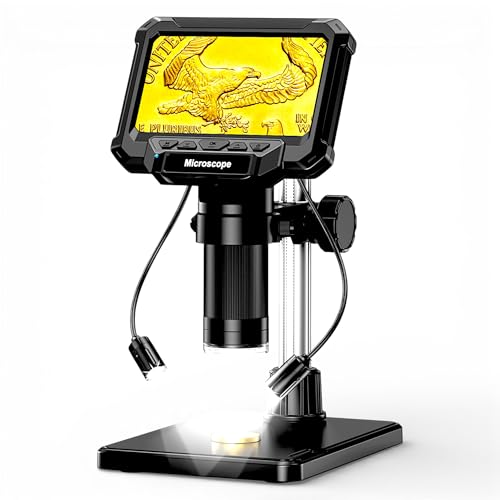
Surface relief can disappear under a flat ring of light, especially on a reflective coin where a bright hotspot washes over a date or mint mark. This Aikokkl model addresses that problem with eight built-in LEDs and two detachable auxiliary side lamps. Directional light can help a collector inspect a small region from a second angle, although it cannot guarantee that every visible line is a genuine mint-made feature.
The 4.3-inch LCD is intended for localized close-ups, and the product information specifically cautions that it cannot show the entire view of large coins such as Morgan dollars or Silver Eagles. That limitation is useful to know before purchase. The microscope records 10MP photos and 1080P video, requires a separate microSD or TF card for saving files, and offers USB Type-C PC live view through a camera mode described for Windows and Mac.
Pros
- Includes two detachable side lamps alongside eight built-in LEDs for directional illumination.
- Uses a focus wheel and bracket-height adjustment for localized surface inspection.
- Provides 1080P video and 10MP photo capture.
- Supports PC live view through USB Type-C on Windows and Mac as described in the listing.
- Explicitly identifies its close-up focus for doubled dies, repunched mint marks, scratches, and similar details.
Cons
- The 4.3-inch screen cannot capture the entire view of large coins according to the product information.
- A microSD or TF card is required for saving photos and videos, and the card is not included.
Collectors examining one date, letter, or raised feature at a time should look closely at this model’s lighting arrangement. The Elikliv full-view microscope is a better match for broad coin coverage, while the Aikokkl is more focused on a small inspection zone and a recordable computer-connected workflow.
To buy this product, click here.
6. Aikokkl 4.3" LCD Digital Coin Microscope with LED Light — Best for Standalone Close-Up Viewing
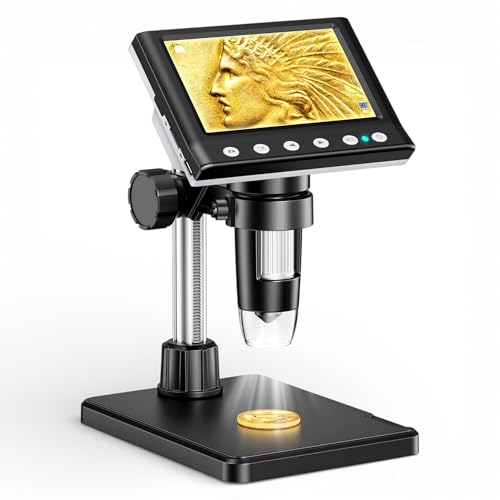
This Aikokkl takes a simpler route than the side-light model. Its 4.3-inch display works as a standalone viewing system, with no software, WiFi, or external monitor required according to the product information. That is useful for a collector who wants to place a coin under the lens, adjust the focus wheel, and inspect a localized feature without building a computer-based station.
Eight dimmable ring LEDs provide control over brightness on reflective surfaces, and the listing describes a weighted base with a rotary focus wheel. The advertised 50X to 1000X range should be read as a magnification claim, not a resolution guarantee. The product is aimed at extreme close-ups rather than full views of large coins, so a broad comparison session may feel more constrained than it would on a 7-inch or larger display.
Pros
- Provides standalone viewing through an integrated 4.3-inch LCD.
- Includes eight dimmable ring LEDs for brightness adjustment on reflective objects.
- Uses a rotary focus wheel for distance control during close-up inspection.
- Is described as suitable for coin dates, mint errors, jewelry textures, and watch details.
- Includes a charging cable and user manual as part of the starter kit.
Cons
- The published information does not identify photo or video recording capability for this model.
- The advertised 50X–1000X range does not establish optical magnification or full-coin coverage.
This is a sensible fit for a small inspection area where immediate LCD viewing matters more than computer documentation. Choose the side-light Aikokkl if directional illumination and saved images are central to the task, or move to a larger-screen model if whole-coin context matters during error inspection.
To buy this product, click here.
7. Elikliv Microscope, Digital Coin Microscope 1000x with Lights, EDM4, 4.3" | 8 Adjustable LED Lighting, 720P LCD Microscope, Built-in Rechargeable Battery, Take Photos/Videos, Windows/MacBook Compatible — Best Value-Focused Coin Microscope

The EDM4 is a straightforward option for a collector who wants a screen, adjustable lighting, a stand, and computer viewing without stepping up to a larger 7-inch system. Its 4.3-inch 720P LCD shows the live image directly, while the height-adjustable stand changes the camera-to-object distance. That adjustment matters because the useful view of a coin depends on the relationship between the lens, the subject, and the display, not on the advertised 1000X figure alone.
Eight adjustable LEDs help illuminate dates, lettering, and small surface features, and the built-in rechargeable battery is specified for up to three hours of continuous use. Photos and videos can be captured for later review, though the listing says a memory card is required and does not include one. Windows and MacBook compatibility is stated, making this a practical entry point for collectors who want to share a close-up on a computer.
Pros
- Provides a built-in 4.3-inch 720P LCD for direct inspection.
- Includes eight adjustable LED lights for brightness control.
- Uses a height-adjustable stand to change camera-to-object distance.
- Supports photo and video capture for later collection records.
- States compatibility with Windows and MacBook computers.
Cons
- A memory card is required for photo and video storage but is not included.
- The 4.3-inch display offers less viewing area than the larger-screen alternatives.
The EDM4 fits buyers who want the core coin-inspection workflow at a lower stated price and can accept a compact screen. The DM9 is better equipped for shared viewing, storage, and lighting flexibility, while the EDM4 keeps the setup smaller and more basic.
To buy this product, click here.
8. TOMLOV P10 Microscope for Adults Kids, Handheld Coin Magnifier with Light — Best for Portable Inspection
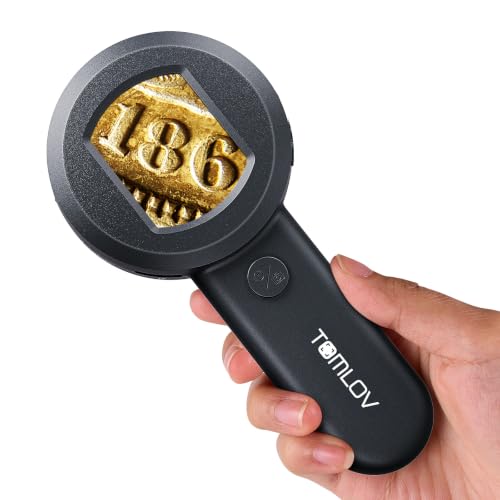
The P10 is built around quick handheld checks rather than a full bench station. It weighs 3.9 ounces, uses a 2-inch LCD, and focuses at a specified distance of 0.3 inches for its fixed 100X view. That makes it useful for a coin show, storage box, classroom, or any place where carrying a stand and larger screen would be awkward.
Its lighting system combines four adjustable white LEDs with four UV LEDs, and the built-in memory can hold up to 300 photos according to the listing. A 16MP camera and computer connection add documentation options, while the stated runtime reaches up to 50 minutes. That short operating period is a real trade-off for portability, and the fixed-focus design offers less positioning flexibility than a height-adjustable microscope.
Pros
- Weighs 3.9 ounces for easy handheld use away from a fixed workbench.
- Provides a 2-inch LCD for viewing without a separate monitor.
- Uses fixed 100X magnification with 4X zoom for quick close-ups.
- Combines four white LEDs with four UV LEDs, with adjustable white-light brightness.
- Includes a 16MP camera and built-in memory for up to 300 photos.
Cons
- The listed runtime is up to 50 minutes, shorter than the multi-hour figures supplied for several stand-based models.
- The fixed-focus design offers less camera-to-object adjustment than a height-adjustable stand.
Take the P10 seriously if portability is the deciding factor and the inspection usually involves one small coin feature at a time. A 4.3-inch stand-based model will give more room for sustained comparison, while the P10 is easier to grab for a fast look and a stored reference image.
To buy this product, click here.
9. Leipan 4.3" Coin Microscope Coin Magnifier, 1980P HD Digital Microscope — Best for Basic LCD Recording

The Leipan presents a simple inspection path: a 4.3-inch IPS screen, one-click photo and video capture, and an advertised 50X to 1000X range. For a collector who wants a direct view of dates, lettering, or small marks without a long list of specialized features, that basic arrangement may be enough. As with the other microscopes in this category, the magnification label does not establish how much additional detail the optics can resolve.
The product information also describes a USB microscope suitable for small and large structures, with an upgraded battery life but no specific runtime supplied. It does not clearly identify the lighting system, storage method, computer operating systems, or exact stand configuration. Those gaps make the Leipan harder to match precisely to a documentation-heavy workflow, yet its IPS display and one-click capture give it a clear role as a simple LCD inspection tool.
Pros
- Provides a 4.3-inch IPS screen for direct coin viewing.
- Offers one-click photo and video capture.
- Advertises a 50X–1000X magnification range for different close-up scales.
- Is described as a USB microscope for hobbyist and inspection applications.
- Includes an upgraded battery-life claim for longer use, though no runtime is specified.
Cons
- The published information does not clearly specify the lighting arrangement.
- The listing does not clearly identify the storage method, operating-system compatibility, or exact stand configuration.
The Leipan suits a buyer who wants an uncomplicated screen-based microscope and does not need the DM9’s documented lighting system, included storage, or larger display. If saved images, PC compatibility, or reflective-coin lighting are central, the more fully specified alternatives are easier to evaluate against the task.
To buy this product, click here.
Buying Guide
Start With The Size Of The Feature
Coin error inspection usually begins with a small area, such as a mint mark, date, lettering edge, or doubled design element. A 4.3-inch microscope can work well for that localized view, especially when the stand or focus wheel allows the camera position to change. A 7-inch or 10.1-inch display becomes more useful when the inspection involves comparing several areas, showing the image to another person, or keeping more of the coin visible at once.
Large-coin coverage deserves separate attention. The Elikliv full-view model specifies coverage up to 38.2 mm, while the Aikokkl side-light model explicitly warns that large coins may not fit entirely in its view. That difference affects how often the coin must be repositioned and how easily a small mark can be placed in context.
Read Magnification Claims Carefully
A number such as 1000X can make a product listing look decisive, but magnification only describes enlargement. Resolution determines whether two nearby edges or lines can be distinguished, and the supplied product information does not provide a common optical-resolution measurement for these models. Digital zoom can make an image larger without revealing new specimen detail.
For error inspection, a controllable focus, useful field of view, and suitable illumination may matter more than the highest advertised number. The P10’s fixed 100X setting, for example, serves a different purpose from the DM9’s advertised 1200X range, yet the larger number alone does not establish that the DM9 resolves every feature better.
Choose Lighting That Reveals Relief
Coins are reflective, and a bright ring can create a white glare patch across the exact lettering or date being examined. Adjustable brightness helps manage that problem. Side lighting can add another angle, making raised relief and fine scratches easier to compare visually, although lighting cannot determine whether a mark is a genuine mint error.
The DM9 and DM10 pair ring LEDs with flexible gooseneck lights. The Elikliv full-view model uses lens LEDs and side lights, while the Aikokkl side-light model adds detachable auxiliary lamps. A single built-in light, such as the one documented for the DM4W, keeps the device simpler but offers fewer described lighting positions.
Decide Whether You Need A Stand
A handheld microscope is convenient for a quick look, but a stand changes the inspection rhythm. It lets the coin remain on the base while the camera height, focus, and viewing range are adjusted. That can be valuable when comparing a normal example with a possible error or capturing several images at the same scale.
Stand height should not be confused with working distance. A tall stand does not automatically establish how much room exists beneath the lens for tools or specimen handling. The supplied products describe stand dimensions or adjustment features, but they do not provide a standardized working-distance measurement, so buyers who need substantial clearance should verify that detail before purchase.
Plan The Image-Recording Workflow
Photos and video are useful for cataloging, comparison, and asking for a second opinion. The DM9 records 12MP photos and 1080P video and includes a 16GB card. The DM10 supports selectable photo sizes up to 16MP, 1080P video, and an included microSD card. Several smaller models require a card that is not included, which adds a small but relevant setup step.
Image dimensions do not prove native sensor resolution or optical detail. A high-number photo file may still contain enlarged or processed data, and a saved close-up does not automatically document a genuine mint error. Keep the original context, lighting position, and coin orientation with each image so comparisons remain meaningful.
Use Weight As Supporting Evidence
A built-in scale can speed up sorting and comparison. The TOMLOV DM4W and Elikliv full-view model both document 0.1 g readability, and the Elikliv model provides a stated 0 to 300 g range. Weight can flag a coin for closer review, especially when comparing similar pieces, but it cannot establish authenticity by itself.
Visual inspection has the same boundary. A microscope can reveal a doubled-looking edge, a repunched mark, or a scratch, but deciding whether the feature is a recognized mint error requires numismatic judgment and comparison with reliable references. Treat the microscope as an observation and documentation tool rather than an automatic grading or authentication system.
Best Digital Microscopes for Coin Error Inspection FAQ
What Magnification Is Best For Coin Error Inspection?
There is no single useful number for every coin or feature. Localized marks may benefit from higher enlargement, while a broader view helps place the mark in context. Advertised magnification should be treated cautiously because it does not establish optical resolution, and digital enlargement may add size without adding detail.
Can A Digital Microscope Confirm A Genuine Mint Error?
No. A microscope can show surface features such as lettering edges, mint marks, scratches, and possible doubling. It cannot independently determine whether a feature is a genuine mint error, post-mint damage, wear, or an artifact of lighting. Confirmation requires numismatic comparison and judgment beyond the image alone.
Is A 4.3-Inch Screen Large Enough For Coin Inspection?
It can be sufficient for localized close-ups of dates, mint marks, and small surface areas. A larger 7-inch or 10.1-inch screen is more suitable for shared viewing, broader comparisons, or reducing the need to reposition larger coins. The right size depends on whether the task centers on one feature or the whole coin.
Why Does Lighting Matter On Reflective Coins?
Polished metal can reflect a ring light directly into the camera, creating glare that hides relief. Adjustable brightness and angled side lighting can change the way raised details and scratches appear. Better lighting makes observation easier, but it does not turn an uncertain feature into a confirmed error.
Do I Need A Memory Card?
Only if the selected microscope requires one for local photo or video storage. The DM9 includes a 16GB card, and the DM10 includes a pre-installed microSD card. The Elikliv EDM4 and Aikokkl side-light model state that a card is required or useful but do not include one, so check the individual listing before setting up a recording workflow.
Is A Built-In Scale Useful For Coin Collectors?
Yes, a scale can help compare weights, sort coins, and flag pieces for further review. The TOMLOV DM4W and Elikliv full-view model document 0.1 g readability. Weight is supporting information, though. It does not independently prove authenticity, purity, or market value.
Can These Microscopes Show An Entire Morgan Dollar?
Coverage varies. The Elikliv full-view model specifically documents a field of view up to 38.2 mm, while the Aikokkl side-light listing says its 4.3-inch screen cannot show the entire view of large coins such as Morgan dollars or Silver Eagles. Compact microscopes may require repositioning or may be better suited to a detail section.
Do Higher Megapixel Numbers Guarantee Better Coin Photos?
No. Captured image size, native sensor resolution, optical resolution, focus, lighting, and glare all affect the usefulness of a photo. A 16MP capture setting does not automatically prove that the microscope resolves more coin detail than a model with a lower stated photo setting.
Final Verdict
The TOMLOV DM9 is the strongest overall fit for coin error inspection because its documented feature set supports the full workflow: a larger 7-inch screen, adjustable stand, eight built-in LEDs, two flexible side lights, PC viewing, photo and video capture, and included storage. It gives a collector more ways to inspect and document a suspicious feature without making the decision rest on an advertised magnification number alone.
Different priorities point elsewhere. The Elikliv full-view model is better for larger coins, broad coverage, and weighing. The TOMLOV DM10 favors a large display and detailed recording, while the Aikokkl side-light model suits localized marks that benefit from angled illumination. For travel or quick checks, the TOMLOV P10 is easier to carry, with the trade-off of a smaller screen, fixed focus, and shorter stated runtime.
