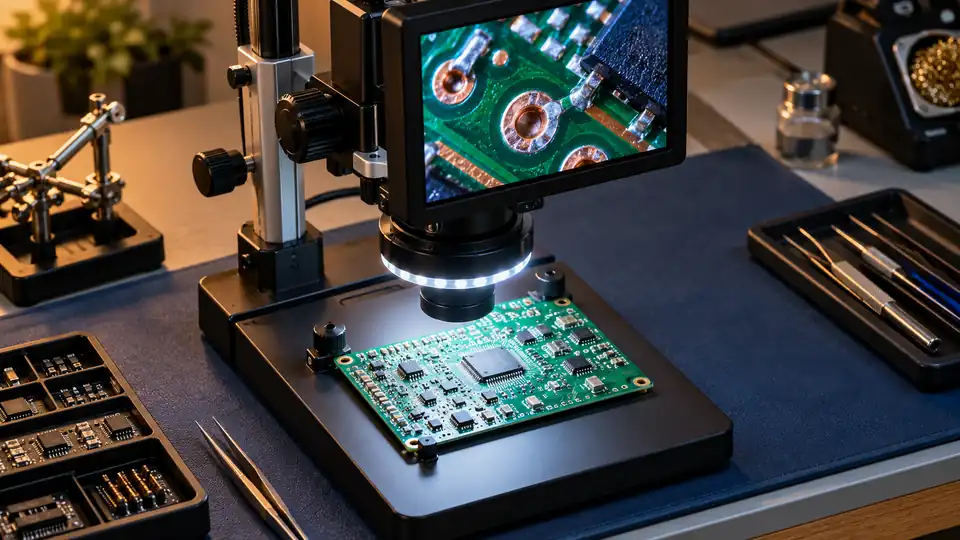
PCB inspection places unusual demands on a digital microscope. A coin or leaf can sit still beneath a lens, but a circuit board may need close viewing while tweezers, probes, and a soldering iron move around it. The useful question is therefore less about the biggest advertised magnification and more about working clearance, focus control, lighting, viewing method, and how securely the camera can be positioned.
A large screen can make long inspection sessions easier to follow, while HDMI or USB output may suit a bench where the image needs to appear on a separate monitor or computer. Adjustable lighting matters around shiny solder joints, and a flexible or boom-style stand can determine whether tools actually fit beneath the lens. Compact handheld models have their place, but their short focus ranges and lighter mounting arrangements may be awkward for detailed board repair.
The selections below cover several different PCB workflows. The TOMLOV TM4K-AF Flex offers autofocus and a large screen, while the Andonstar AD246S-M provides interchangeable lenses and HDMI output. The TOMLOV TM3K-3D takes a different approach with side-viewing, and lower-cost models such as the Aikokkl and Elikliv EDM4 keep the setup simpler for occasional inspection.
Quick Answer
- Best Overall: TOMLOV Autofocus 4K Digital Microscope, 8″ TM4K-AF Flex Arm for Soldering for autofocus, preset focus points, a flexible arm, and a large built-in screen.
- Best for Flexible Viewing: TOMLOV 3D Digital Soldering Microscope TM3K-3D, 7″ Magnetic Dual Lens Scope for side-viewing, dual lenses, HDMI, USB, and adjustable illumination.
- Best for HDMI and Multiple Lenses: Andonstar AD246S-M 3 Lens 2160P HDMI Digital Microscope 2000x for Adults for its interchangeable lens set and HDMI output.
- Best Value for Basic PCB Work: Aikokkl 5″ LCD Digital Soldering Microscope for PCB Repair with C-Clamp for its built-in display, flexible arm, and PC camera mode.
Best Digital Microscopes for PCB Inspection Comparison Table
| Product | Best For | Viewing System | PCB-Relevant Features | Image Capture or Output |
|---|---|---|---|---|
| TOMLOV Autofocus 4K Digital Microscope, 8″ TM4K-AF Flex Arm for Soldering | Autofocus bench inspection | 8″ screen | TOF autofocus, P1/P2 focus points, 360° arm | 4K video, 52MP images listed |
| TOMLOV 3D Digital Soldering Microscope TM3K-3D, 7″ Magnetic Dual Lens Scope | Side-view inspection | 7″ IPS screen | 3D rotation, long-distance lens, gooseneck light | HDMI and USB output |
| Andonstar AD246S-M 3 Lens 2160P HDMI Digital Microscope 2000x for Adults | Multiple inspection tasks | 7″ LCD screen | Repair lens, adjustable boom arm, eight lighting levels | 2160P video, HDMI, 32GB card |
| TOMLOV DM9 Max 10.1″ Digital Soldering Microscope | Large-screen board work | 10.1″ IPS screen | 12.6″ stand, large base, dimmable lights | 20MP photos, 1080P video, PC/TV connection |
| Andonstar AD210 10.1 Inch LCD Digital Microscope for Soldering, Coin | Adjustable working distance | 10.1″ IPS screen | 1cm to 26cm stated range, adjustable stand, top and side lights | 12MP photos, 1080P video, 32GB card |
| Aikokkl 5″ LCD Digital Soldering Microscope for PCB Repair with C-Clamp | Budget PCB inspection | 5″ IPS screen | Flexible arm, manual focus, PC camera mode | 1080P recording with optional Micro SD card |
| Elikliv Microscope, Digital Coin Microscope 1000x with Lights, EDM4, 4.3″ | Low-cost occasional inspection | 4.3″ LCD screen | Height-adjustable stand, eight LEDs | PC viewing, photos and video |
| Elikliv Coin Microscope with Weighing Scale, Digital Magnifier 8+2 Lights | PCB inspection with weighing tasks | 4.3″ IPS screen | Handheld design, ten LEDs, metal base | 12MP photos, 1080P video, USB PC view |
| Wireless Digital Microscope, Skybasic 50X-1000X Magnification | Portable board checks | Phone, tablet, or computer | Handheld body, adjustable stand, 3–60mm focal range | WiFi and USB, 1080P phone images |
The best fit depends on whether the board needs hands-on clearance, side-view access, a separate monitor, or a compact inspection tool.
1. TOMLOV Autofocus 4K Digital Microscope, 8″ TM4K-AF Flex Arm for Soldering — Best Overall

PCB boards are full of height changes. A connector rises above the board, a chip sits lower, and a solder joint can disappear as the viewing angle shifts. This TOMLOV model is the most feature-rich option here for that kind of work because its supplied specifications identify TOF autofocus, AI-driven focus adjustment, and two preset focus points. P1 and P2 can be useful for moving between two inspection depths without repeatedly starting from scratch.
The 360-degree articulating arm gives the camera more positioning options than a simple fixed column, while the 8-inch screen keeps the image separate from the work area. The product information lists 4K video and 52MP images, but those labels should be read as capture specifications rather than proof of equivalent optical detail. It is also the most expensive model in this group, so its automation matters most for frequent board inspection rather than occasional checks.
Pros
- Uses documented TOF autofocus for automatic focus adjustment.
- Provides P1 and P2 preset focus points for uneven subjects.
- Includes an 8-inch built-in screen.
- Uses a 360-degree articulating flex arm.
- Lists 4K video and 52MP image capture.
Cons
- It has the highest listed price among these selections.
- The published specifications do not clearly identify the microscope’s working-distance measurement.
This is the strongest fit for frequent PCB inspection where autofocus and flexible positioning are worth paying for. Buyers who prefer manual control, a lower price, or interchangeable lenses may find the Andonstar AD246S-M a better match.
To buy this product, click here.
2. TOMLOV 3D Digital Soldering Microscope TM3K-3D, 7″ Magnetic Dual Lens Scope — Best for Side-View PCB Inspection
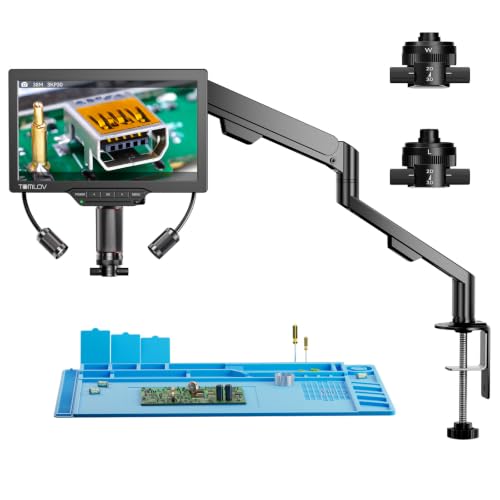
Some board faults are easier to understand from the side. A component lead, connector edge, or raised solder joint may look acceptable from above while a profile view tells a different story. The TM3K-3D is the unusual pick in this group because its supplied features emphasize side-viewing and 360-degree 3D rotation, giving inspection a different perspective than a conventional straight-down digital microscope.
The magnetic L and W lenses also divide the work sensibly. The L lens is described as a long-distance option for soldering and micro-repair, while the W lens provides a wider view for larger subjects. A 7-inch IPS screen, HDMI connection, USB connection, and adjustable gooseneck spotlight make this a flexible bench system. The listing does not provide a precise working-distance figure, so the long-distance description should not be treated as a measurement.
Pros
- Supports documented side-viewing and 360-degree 3D rotation.
- Includes magnetic L and W lenses.
- Provides a 7-inch IPS display.
- Offers HDMI, USB, and built-in screen viewing.
- Uses an adjustable LED gooseneck spotlight.
Cons
- The published specifications do not state a precise working-distance range.
- The 3D viewing system may be unnecessary for simple top-down board checks.
Choose this model for components whose shape or solder profile deserves inspection from more than one angle. A conventional large-screen model such as the TOMLOV DM9 Max is a simpler route for buyers who mainly need overhead viewing and broad board access.
To buy this product, click here.
3. Andonstar AD246S-M 3 Lens 2160P HDMI Digital Microscope 2000x for Adults — Best for HDMI and Multiple Lenses

The AD246S-M is built around a three-lens system rather than a single all-purpose view. Its L lens is identified for circuit-board repair, while the supplied A and D lenses cover whole objects and slides. For a bench that moves between electronics, coins, and prepared slides, swapping lenses can be more useful than chasing a larger advertised magnification number.
Its adjustable boom arm can move front to back, side to side, and by angle, which gives a board more room beneath the camera than a small handheld stand. HDMI output supports display on a compatible larger monitor, and the 7-inch LCD remains available for standalone viewing. The listing also identifies eight lighting intensity levels, a remote, measurement software for Windows, and a supplied 32GB Micro SD card. The software’s practical measurement accuracy is not established by those features alone.
Pros
- Includes three documented lenses for different observation tasks.
- Provides HDMI output for a compatible external display.
- Uses an adjustable boom arm with front, rear, side, and angle adjustment.
- Offers eight lighting intensity levels.
- Includes a 32GB Micro SD card and remote control.
Cons
- The lens-swapping workflow is less immediate than a fixed single-lens setup.
- Windows measurement software is supplied, but measurement accuracy is not specified.
This is a practical choice for a shared inspection station that needs HDMI viewing and multiple optical configurations. For a dedicated PCB bench with less need for slides or whole-object viewing, the autofocus TOMLOV may offer a more direct workflow.
To buy this product, click here.
4. TOMLOV DM9 Max 10.1″ Digital Soldering Microscope, Full View Coin Magnifier — Best Large-Screen Stand

A cramped viewing setup can turn a straightforward board repair into a dance of elbows, tweezers, and cables. The DM9 Max addresses that physical problem with a 12.6-inch metal stand, a larger base, and extra room described for circuit boards, soldering irons, and hand movement. Its 10.1-inch IPS display is the largest built-in screen among the main bench-oriented options here.
The camera can show a full coin up to the stated 30.61mm size, which also signals a wider-view orientation for larger inspection subjects. Ten LEDs combine eight around the lens with two gooseneck side lights, and both lighting groups are described as dimmable. A wireless remote, pre-installed Micro SD card, 20MP photos, and 1080P video add documentation conveniences. The product listing does not clearly identify the native sensor resolution or a precise optical magnification basis for its 5X to 1500X range.
Pros
- Provides a 10.1-inch IPS display.
- Uses a documented 12.6-inch metal stand and larger base.
- Offers eight lens LEDs and two adjustable side lights.
- Supports PC and TV connections.
- Includes 20MP photos, 1080P video, and a pre-installed Micro SD card.
Cons
- The listing does not clearly identify the native sensor resolution.
- Its large stand occupies more bench space than compact handheld options.
Buyers with a fixed repair station and larger boards should look closely at this model’s stand and screen combination. Aikokkl’s smaller flex-arm design is easier to fit into a tight workspace, while the DM9 Max favors roomier benches.
To buy this product, click here.
5. Andonstar AD210 10.1 Inch LCD Digital Microscope for Soldering, Coin — Best for Adjustable Working Distance

The AD210 is one of the few products here with a stated adjustable working-distance range, listed as 1cm to 26cm. That range matters for PCB inspection because the space between lens and board affects access for tools and the ability to move between small components and broader sections. The published information also identifies a stand height of up to 12.6 inches, although stand height should not be confused with the optical working distance.
A 10.1-inch IPS display, remote control, adjustable top and side lighting, and a supplied 32GB card support a straightforward standalone workflow. The bottom light stage and slide kit add biological observation functions, though they do not make this a substitute for a compound microscope. For board work, the key attraction is the combination of a larger screen, adjustable positioning, and multiple lighting types.
Pros
- Lists an adjustable working-distance range of 1cm to 26cm.
- Provides a 10.1-inch IPS display.
- Includes adjustable top, side, and bottom illumination.
- Offers remote control for capture, recording, zoom, and image color adjustment.
- Includes a 32GB memory card and card reader.
Cons
- The product includes biological accessories that may add little value for a PCB-only bench.
- The supplied information does not identify a dedicated long-distance soldering lens.
This model suits buyers who want a broad, adjustable setup that can handle boards and other objects. The AD246S-M is a better fit for users who specifically want interchangeable lenses and HDMI output.
To buy this product, click here.
6. Aikokkl 5″ LCD Digital Soldering Microscope for PCB Repair with C-Clamp — Best Value for Basic PCB Inspection

The Aikokkl keeps the core PCB workflow compact: a 5-inch IPS screen, a flexible gooseneck arm, and manual focus. The listing is unusually clear that this is not an autofocus camera. Magnification is adjusted by changing the camera-to-object distance, then turning the focus wheel. That means the operator must reposition the arm and refocus rather than expect the camera to track height changes automatically.
For a modest repair station, the C-clamp and flexible arm may be easier to place than a tall floor-style stand. PC Camera mode supports viewing through the built-in Windows Camera application or Mac Photo Booth, and the product information identifies 1080P recording. A Micro SD card up to 32GB is required for saving larger batches of photos and repair videos, but the card is not included.
Pros
- Includes a 5-inch IPS built-in display.
- Uses a flexible multi-angle gooseneck arm.
- Provides PC Camera mode for Windows and Mac viewing.
- Lists 1080P repair video recording.
- Uses manual focus and distance adjustment without requiring autofocus.
Cons
- It does not provide autofocus.
- A Micro SD card is required for larger photo and video storage and is not included.
This model makes sense for occasional solder-joint checks and smaller work areas where a compact clamp-mounted setup is preferable. Users who need more screen space, documented board clearance, or automated focusing should move up to the TOMLOV TM4K-AF Flex or DM9 Max.
To buy this product, click here.
7. Elikliv Microscope, Digital Coin Microscope 1000x with Lights, EDM4, 4.3″ — Best Low-Cost Standalone Option

The EDM4 is a small LCD microscope for buyers who want basic close-up viewing without building a larger bench system. Its 4.3-inch screen, eight adjustable LEDs, and height-adjustable stand support inspection of solder joints, connectors, and component markings. The stand changes the camera-to-object distance, which is more useful for PCB work than treating the advertised 1000x figure as a guarantee of fine optical resolution.
Windows and MacBook PC viewing lets a larger computer screen take over when the built-in display feels restrictive. The product also includes a rechargeable battery with up to three hours of stated continuous use, plus photo and video recording. A memory card is needed for storage but is not included. The smaller screen and stand make this better suited to occasional inspection than to a busy repair bench with frequent tool access.
Pros
- Provides a 4.3-inch LCD display.
- Includes eight adjustable LED lights.
- Uses a height-adjustable stand.
- Supports Windows and MacBook computer viewing.
- Lists up to three hours of continuous battery use.
Cons
- The published specifications do not identify a precise working-distance range.
- A memory card is required for saved photos and videos but is not included.
This is a sensible entry-level pick for infrequent board checks, especially if portability matters more than a large repair envelope. Aikokkl’s flexible arm is more purpose-built for PCB positioning, while the EDM4 offers a lower-cost general-purpose format.
To buy this product, click here.
8. Elikliv Coin Microscope with Weighing Scale, Digital Magnifier 8+2 Lights — Best for Inspection Plus Weighing
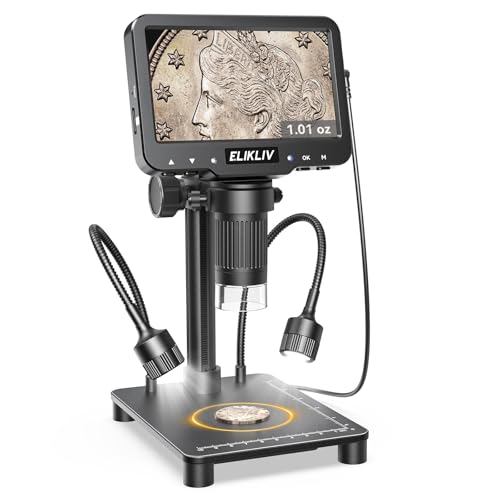
This Elikliv is an unusual fit for PCB inspection because its main extra feature is a built-in scale. The scale is listed with 0.1g resolution and capacity up to 300g, while the microscope portion provides a 4.3-inch IPS screen, ten LEDs, and a handheld design. That combination could suit someone who checks small electronic parts or components and also weighs coins, jewelry, or other objects.
For circuit boards, the useful parts are the adjustable lens and side lighting, the metal base, and USB PC viewing. The listing identifies 12MP photos, 1080P video, and up to three hours of working time. It is less focused on hands-on soldering than the long-arm models, and its scale adds cost and bulk without improving the image itself. The weighing feature should also be treated as a measurement function for mass, not evidence that the microscope can authenticate a component or diagnose a board.
Pros
- Combines digital inspection with a scale listed at 0.1g resolution.
- Provides eight lens LEDs and two side lights.
- Includes a 4.3-inch IPS screen.
- Supports USB PC viewing.
- Lists 12MP photos and 1080P video recording.
Cons
- The handheld format provides less documented workspace than the dedicated soldering stands.
- The scale is irrelevant to buyers who only need PCB imaging.
Pick this model if weighing is part of the same workbench routine as visual inspection. For soldering access and precise camera positioning, the Aikokkl, AD210, or one of the TOMLOV arm systems is a more direct choice.
To buy this product, click here.
9. Wireless Digital Microscope, Skybasic 50X-1000X Magnification WiFi Portable Handheld Microscopes — Best Portable PCB Inspection Tool

The Skybasic is the smallest and most mobile option in this roundup. It connects over WiFi to Android or iOS devices and over USB to Windows or Mac computers, so it can be carried to a board rather than requiring a permanent stand. The supplied focal range is 3mm to 60mm, which gives a useful starting point for positioning the lens near a component or solder joint.
Eight adjustable LEDs and one-button capture support quick visual checks, while the listing identifies 1080P images on smartphones and 720P output on computers. The product information also describes it as closer to a fixed-focus magnifying glass than a traditional microscope. That limitation matters on a repair bench, where tool clearance, stable mounting, and consistent focus can matter more than portability.
Pros
- Supports WiFi viewing on Android and iOS devices.
- Provides USB computer connectivity for Windows and Mac.
- Lists a 3mm to 60mm focal length range.
- Includes eight adjustable LED lights.
- Offers one-button photo and video capture.
Cons
- The listing describes it as a fixed-focus magnifying glass rather than a traditional microscope.
- Computer output is listed at 720P, lower than the stated smartphone image output.
This is the right kind of tool for quick checks away from a permanent bench or for examining a small board before deciding whether a repair needs closer work. It is a poor substitute for a long-arm soldering microscope when active tool access and stable positioning are central.
To buy this product, click here.
How to Choose a Digital Microscope for PCB Inspection
Start With Tool Clearance, Not the Magnification Number
Soldering requires room beneath the camera for a tip, tweezers, and the board itself. A stated working-distance range, long-distance lens, or repair-oriented arm gives more useful information than a headline such as 1000x or 2000x. Advertised magnification may include digital enlargement or display scaling, so it should not be treated as a direct measure of resolved detail.
Choose the Viewing Arrangement That Matches the Bench
A built-in LCD screen keeps the microscope self-contained and avoids tying up a computer. USB viewing can be useful for a larger computer display, image organization, or shared analysis, while HDMI sends the video signal to a compatible monitor. Check the specific product information carefully because USB, HDMI, recording, and computer control are separate functions.
Look for Positioning That Keeps the Board Accessible
A flexible arm, boom arm, or adjustable stand can change how easily a board moves beneath the lens. A small handheld model may work for a quick static check, but a repair bench often benefits from a mount that leaves both hands available. Stand height is not the same as optical working distance, so avoid assuming that a tall stand automatically creates more focus clearance.
Use Lighting to Reveal Solder Details
Solder and exposed metal can throw bright reflections directly back toward the camera. Adjustable ring LEDs, side lights, or a movable spotlight let the operator change the direction and intensity of illumination. More LEDs do not automatically mean better images. The useful feature is control over glare, shadows, and contrast around the joint.
Decide Whether Autofocus Is Worth the Extra Cost
Manual focus can be perfectly workable on a flat board when the camera stays at one height. Autofocus and preset focus points become more attractive when components vary in height or the inspection frequently moves between two surfaces. The trade-off is price and system complexity. The TOMLOV TM4K-AF Flex is the clearest autofocus option here, while the Aikokkl uses deliberate manual distance and focus adjustment.
Separate Image Capture From Optical Detail
Photo and video numbers describe saved or displayed media, not necessarily native sensor detail or optical resolution. A 4K video label or high-megapixel photo claim can help with documentation, but it does not prove that the lens resolves every corresponding fine feature. For PCB records, also check whether a Micro SD card is included, required, or replaceable.
Match the Microscope to the Repair Type
Visual inspection, soldering, component identification, and documentation place different demands on a microscope. A wide view can help locate a connector or trace, while a closer view may reveal a small bridge. Side-view capability can help with component profiles, but a large stand and open working area may matter more for hands-on repair. A microscope makes a defect easier to see, but it does not establish the electrical cause of a board failure by itself.
Best Digital Microscopes for PCB Inspection FAQ
What Magnification Is Needed for PCB Inspection?
There is no single useful number for every board. A wider view helps locate components and traces, while higher displayed enlargement can assist with small solder features. Advertised magnification may include digital scaling, so working distance, focus control, lighting, and effective image detail deserve equal attention.
Is A Built-In Screen Better Than Using A Computer?
A built-in screen supports a standalone bench and keeps the microscope ready without opening software. Computer viewing can provide a larger shared image and easier file organization. Products such as the Aikokkl, TOMLOV DM9 Max, and Andonstar AD210 combine an onboard display with computer or external-screen options.
Does HDMI Make A Microscope Better for PCB Work?
HDMI is useful when a compatible monitor is part of the inspection setup, especially for shared viewing. It does not automatically establish a particular resolution, latency, or recording function. Confirm those capabilities separately in the product specifications.
Is Autofocus Useful While Soldering?
Autofocus can help when the board includes components at different heights or the camera frequently changes position. Manual focus may be simpler for a flat board that stays at one working height. Autofocus also does not replace a suitable stand or create working clearance by itself.
Do I Need A Long Working Distance For PCB Inspection?
A longer working distance can leave more space for tools and board handling, but the exact requirement depends on the repair task and lens configuration. A stated working-distance range or long-distance lens is more useful evidence than a tall stand or a large magnification claim.
Can A Digital Microscope Show Solder Bridges?
A suitable digital microscope can enlarge visible surface details such as solder bridges, damaged pads, and component markings. Lighting angle and focus affect what appears in the image. Visual enlargement does not prove that a joint is electrically sound, so suspicious areas may still require separate electrical testing.
Should I Choose A Handheld Microscope For PCB Repair?
Handheld models are useful for quick checks, tight spaces, and portable work. Their shorter focal arrangements and lighter stands may be less convenient when both hands must manipulate soldering tools. A mounted microscope is usually more practical for repeated bench repair.
Final Verdict
The TOMLOV TM4K-AF Flex is the strongest overall fit for PCB inspection because its documented autofocus system, preset focus points, 8-inch screen, and articulating arm address several recurring bench problems at once. Its 4K and 52MP claims should be read as capture specifications rather than a guarantee of equivalent optical resolution, but the overall configuration is the most complete among these selections.
Different priorities point elsewhere. The TOMLOV TM3K-3D is the specialized pick for side-view inspection, the Andonstar AD246S-M suits HDMI users who want multiple lenses, and the DM9 Max favors a spacious large-screen bench. For simpler or portable work, the Aikokkl, Elikliv EDM4, and Skybasic trade automation or working room for lower cost and easier placement.
