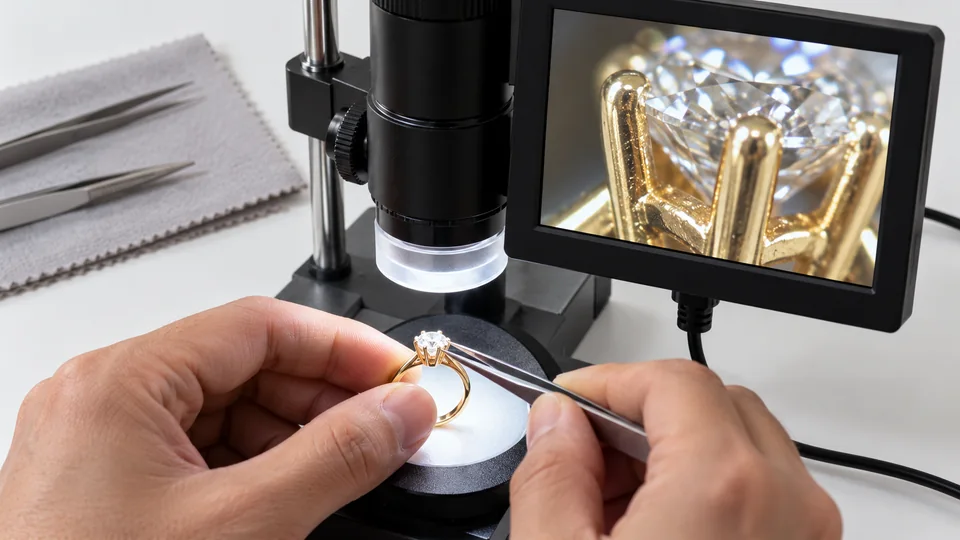
Jewelry inspection rewards a microscope that can reveal tiny surface details without turning every ring, setting, or gemstone into a blur of glare and digital enlargement. A hallmark on the inside of a band, a scratch across polished metal, or a visible inclusion may require careful focus, controllable lighting, and enough room to position the piece beneath the lens.
Advertised magnification can be misleading here. A larger number may enlarge the image without revealing more useful detail, while a fixed-focus pocket microscope may be convenient for a quick check but awkward for inspecting a curved setting. Display size, manual focusing, lighting control, stand design, image capture, and the ability to view jewelry on a phone, computer, or built-in screen matter more than a headline number alone.
The TOMLOV DM9 is the strongest all-purpose choice in this group because it combines a 7-inch screen, adjustable stand, multiple lighting options, image capture, and computer viewing. Buyers who need weighing as part of a jewelry check should look closely at the TOMLOV DM4W or the larger Elikliv 7-inch model, while portable users have more compact choices such as the TOMLOV P50 and P10.
Quick Answer
- Best Overall: TOMLOV DM9 7″ Digital Coin Microscope 1200X, Soldering Scope for Adults | Metal Base, Ultra-Precise Focus, 12MP Photo/1080P Video, 10 LEDs, Error Coin View, PCB Repair, for Collectors, PC View, 16GB for its large built-in screen, adjustable stand, lighting options, and image storage.
- Best With Integrated Weighing: TOMLOV DM4W Microscope with Weighing Scale: 4.3″ Digital Coin Magnifier for inspecting and weighing jewelry or gemstones with one device.
- Best for Manual Focus: Teslong USB-C Digital Microscope 10X-200X for Coin & Electronics Inspection for its focus wheel, adjustable lighting, and rotating stand.
- Best Portable Option: TOMLOV P50 Handheld Digital Microscope, Adjustable Focus, 2.4″ IPS Screen for adjustable focus, a compact body, and jewelry-focused lighting controls.
Best Digital Microscopes for Jewelry Inspection Comparison Table
| Product | Best For | Display | Connection | Advertised Magnification | Jewelry-Relevant Feature |
|---|---|---|---|---|---|
| TOMLOV DM9 | Overall inspection | 7-inch LCD | PC connection | 1200X | Adjustable stand and multiple lights |
| Elikliv EDM4 | Affordable LCD viewing | 4.3-inch, 720P | Windows and MacBook | 1000X | Height-adjustable stand |
| TOMLOV DM4W | Inspection with weighing | 4.3-inch IPS | Windows and macOS | 10X–200X | 0.1 g resolution scale |
| Teslong USB-C Microscope | Manual-focus inspection | Phone or PC view | USB-C | 10X–200X | Three-level light adjustment |
| Skybasic Wireless Microscope | Phone-based viewing | Phone, tablet, or computer | WiFi and USB | 50X–1000X | Wireless image transfer |
| TOMLOV P10 | Quick pocket checks | 2-inch LCD | PC connection | Fixed 100X | White and UV lights |
| Jiusion 4K WiFi Microscope | Phone and tablet viewing | Phone, tablet, or computer | WiFi and USB | 50X–1000X | Phone zoom controls |
| Elikliv 7″ Full View Microscope | Larger pieces and weighing | 7-inch screen | USB PC connection | Not clearly specified | 0.1 g readability and wide view |
| TOMLOV P50 | Portable jewelry inspection | 2.4-inch IPS | PC and macOS connection | Not clearly specified | Adjustable focus and six LEDs |
These choices cover large-screen inspection, portable close-ups, phone viewing, manual focusing, and jewelry checks that benefit from weighing.
1. TOMLOV DM9 7″ Digital Coin Microscope 1200X, Soldering Scope for Adults | Metal Base, Ultra-Precise Focus, 12MP Photo/1080P Video, 10 LEDs, Error Coin View, PCB Repair, for Collectors, PC View, 16GB — Best Overall

The TOMLOV DM9 gives jewelry inspectors a broad, hands-on setup rather than a tiny lens that must be held directly against a ring. Its 7-inch LCD screen keeps the enlarged view on the device, while the adjustable 8.5-inch stand lets users change the camera-to-object position for different pieces and levels of detail. That combination is useful for checking hallmarks, prongs, surface scratches, and small watch or jewelry components.
Lighting is a major part of the appeal. The DM9 combines eight built-in LEDs with two flexible gooseneck lights, so reflective metal can be approached from more than one direction instead of receiving a single bright spot straight down. The product information also identifies a 12MP camera, 1080P video, PC viewing, a 16GB memory card, and a wired remote, giving jewelry makers a practical way to document details without touching the microscope during capture.
Pros
- Built-in 7-inch LCD screen supports standalone viewing.
- Adjustable metal stand changes the camera-to-object position.
- Eight built-in LEDs and two flexible gooseneck lights support varied illumination.
- Supports 12MP photos and 1080P video according to the product information.
- Includes a 16GB memory card and PC connection for saving or sharing inspection records.
Cons
- The advertised 1200X figure does not establish optical resolution or the amount of detail the system can resolve.
- The stand-based setup is less pocketable than the handheld models in this group.
This is the best fit for a jewelry bench, collection archive, or shared inspection setup where a large screen and flexible lighting matter. A portable buyer may prefer the TOMLOV P50, while someone who also needs weight readings should look at the DM4W or Elikliv 7-inch model.
To buy this product, click here.
2. Elikliv Microscope, Digital Coin Microscope 1000x with Lights, EDM4, 4.3” | 8 Adjustable LED Lighting, 720P LCD Microscope, Built-in Rechargeable Battery, Take Photos/Videos, Windows/MacBook Compatible — Best Budget LCD Option

The Elikliv EDM4 keeps the setup straightforward: a 4.3-inch LCD screen, eight adjustable LEDs, and a height-adjustable stand. For a jewelry hobbyist checking a ring setting or a stamped hallmark, the built-in display avoids the need to bring a computer to the work area. Raising or lowering the stand also changes the camera-to-object distance, which is more useful for jewelry than a fixed lens that only shows one narrow working position.
This model includes a rechargeable battery with up to three hours of continuous use according to the listing, plus Windows and MacBook viewing. Photos and videos can be saved, but a memory card is not included, so buyers planning to document gemstones or finished pieces need to supply compatible storage. Its 720P display is clearly identified, while the advertised 1000X figure should be treated as an enlargement claim rather than a direct measure of resolved detail.
Pros
- Includes a built-in 4.3-inch 720P LCD screen.
- Provides eight adjustable LED lights for close-up illumination.
- Uses a height-adjustable stand for changing camera-to-object distance.
- Offers Windows and MacBook computer viewing.
- Includes a rechargeable battery with up to three hours of stated continuous use.
Cons
- A memory card is required for photo and video storage but is not included.
- The smaller 4.3-inch screen provides less viewing area than the TOMLOV DM9 and 7-inch Elikliv model.
Choose the EDM4 for an affordable, self-contained jewelry inspection station with basic computer support. The DM9 is better suited to longer shared viewing and more flexible lighting, while the P50 is easier to carry between work areas.
To buy this product, click here.
3. TOMLOV DM4W Microscope with Weighing Scale: 4.3″ Digital Coin Magnifier — Best With Integrated Weighing

The DM4W is aimed at a specific jewelry workflow: inspect an item, then weigh it without reaching for a separate scale. Its built-in system measures in grams, ounces, and carats, with a stated 0.1 g resolution and ±0.5 g accuracy. That can be useful for documenting jewelry pieces or comparing metal objects, but the scale reading should remain one part of an assessment rather than proof of gemstone identity, purity, or authenticity.
The 4.3-inch IPS screen is specified at 500 cd/m² with a 178-degree viewing angle, and the stand rises to 8 inches according to the product information. Built-in LED illumination keeps the setup compact, while a battery allows cordless use. The stated 10X–200X range is more restrained than the headline numbers on some competing listings, which makes it easier to frame this model around inspection and weighing rather than maximum enlargement.
Pros
- Combines digital inspection with a built-in weighing scale.
- Provides stated 0.1 g resolution and ±0.5 g accuracy for the scale.
- Measures in grams, ounces, and carats.
- Includes a 4.3-inch IPS screen with stated 500 cd/m² brightness.
- Supports USB output to Windows or macOS computers and includes a built-in battery.
Cons
- The 4.3-inch display is smaller than the screens on the DM9 and 7-inch Elikliv model.
- Weight readings and magnified images do not independently establish gemstone identity, metal purity, or authenticity.
This is the practical choice for jewelers, collectors, and resellers who want visual inspection and weight readings in one compact unit. Those who care more about seeing a larger portion of a piece at once should move up to the Elikliv 7-inch model.
To buy this product, click here.
4. Teslong USB-C Digital Microscope 10X-200X for Coin & Electronics Inspection — Best for Manual Focus

The Teslong takes a different route from the LCD microscopes above. It uses a manual focus wheel and USB-C connection, with viewing through a phone, Android device, or PC according to the listing. Manual focus is valuable around jewelry because a ring setting, stone facet, and metal edge can sit at different depths. Instead of relying on autofocus behavior, the user can adjust the lens directly and lock attention onto a hallmark or surface feature.
Its eight LEDs offer three brightness levels, giving reflective metal more than one illumination setting. The rotating metal stand can turn 360 degrees, which helps position the camera for flat pieces, curved rings, or a vertical object. The supplied ear specula, protective covers, and side-view mirror broaden the kit, although those accessories are secondary to jewelry inspection and should not be mistaken for evidence of medical suitability.
Pros
- Provides a manual focus wheel for direct focusing control.
- Offers 10X–200X advertised magnification.
- Includes eight LEDs with three brightness levels.
- Uses a rotating stand for different viewing positions.
- Supports viewing on a phone, Android device, or PC through USB-C according to the product information.
Cons
- It does not include a built-in LCD screen, so viewing depends on a connected device.
- The published information does not clearly specify a native sensor resolution or image-recording resolution.
The Teslong suits someone who values direct focus control and adjustable lighting more than a standalone display. A buyer wanting a self-contained station should choose the DM9 or EDM4 instead, while a phone-first user may prefer the wireless Skybasic or Jiusion models.
To buy this product, click here.
5. Wireless Digital Microscope, Skybasic 50X-1000X Magnification WiFi Portable Handheld Microscopes with Adjustable Stand HD USB Microscope Camera Compatible with iPhone Android iPad Windows Mac Computer — Best Wireless Option

The Skybasic is useful for jewelry inspection that moves around the house, studio, or market table. It creates a WiFi hotspot for Android and iOS devices, and it can connect to Windows or Mac computers through USB. A phone or tablet becomes the viewing screen, which makes it convenient for showing a close-up of a gemstone setting to another person without building a permanent bench setup.
The camera is identified as a 2MP HD CMOS sensor, with 1920×1080 image capture on smartphones and 720P picture quality on computers according to the listing. Eight adjustable LEDs surround the lens, while the product uses a 3–60 mm focal-length range and is described as more like a fixed-focus magnifying glass than a traditional microscope. That limitation matters for jewelry, since curved rings and raised settings may require careful positioning to keep the desired feature within focus.
Pros
- Supports WiFi viewing on iPhone, iPad, and Android devices.
- Provides USB connection for Windows and Mac computers.
- Includes eight adjustable LED lights.
- Supports one-button photo and video capture through the device or app.
- Includes an adjustable stand and a stated 3–60 mm focal-length range.
Cons
- The listing describes the device as more like a fixed-focus magnifying glass than a traditional microscope.
- Computer image quality is listed as 720P, lower than the stated 1920×1080 smartphone capture.
This model fits phone-centered inspection and occasional jewelry checks where portability matters more than a large built-in display. For finer control over a particular hallmark or setting, the manual-focus Teslong or adjustable-focus P50 is a better match.
To buy this product, click here.
6. TOMLOV P10 Microscope for Adults Kids, Handheld Coin Magnifier with Light — Best Compact Inspection Tool
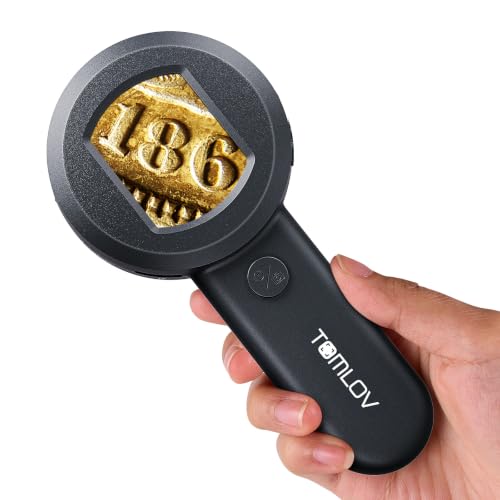
The TOMLOV P10 is built for quick checks rather than a full jewelry workstation. Its 2-inch LCD screen shows the live image directly on the handheld unit, and its fixed 100X magnification with 4X zoom keeps operation simple. For a hallmark, a visible scratch, or a quick look at a gemstone setting, the short setup can be more convenient than arranging a stand and computer.
Lighting is the distinctive feature. The P10 provides four white LEDs and four UV lights, with adjustable white lighting. That gives the user different illumination modes for surface observation, though UV illumination should not be treated as a gemstone identification system. The product also includes 16MP image capture, built-in storage for up to 300 photos, PC connection, and a stated runtime of up to 50 minutes.
Pros
- Includes a built-in 2-inch LCD screen.
- Uses a compact handheld design weighing 3.9 ounces according to the product information.
- Provides fixed 100X magnification with 4X zoom.
- Offers four white LEDs and four UV lights.
- Includes 16MP photo capture, storage for up to 300 photos, and PC connection.
Cons
- The stated runtime is up to 50 minutes, shorter than the battery claims for several larger LCD models.
- Fixed focus offers less adjustment for different jewelry heights than the P50 or Teslong.
The P10 is a sensible pocket tool for quick visual checks, shows, and travel. It is less suitable for long inspection sessions or pieces that demand careful refocusing, where a stand-mounted model or the adjustable-focus P50 will be easier to manage.
To buy this product, click here.
7. Jiusion 4K 50-1000x WiFi USB Digital Handheld Microscope with Metal Stand — Best for Phone and Tablet Viewing

The Jiusion is aimed at buyers who want to use a phone or tablet as the main jewelry display. Its WiFi connection supports iOS and Android devices, while USB connection supports computer use across the operating systems identified in the product information. The supplied metal stand adds hands-free positioning, which is useful when a ring or pendant must remain still while the viewer adjusts focus and lighting.
The listing describes 3840x2160P wireless video transfer and eight built-in LEDs, along with separate focus and brightness controls. That 4K label should be understood as the stated video-transfer specification, not automatic proof that the optics resolve 4K-equivalent jewelry detail. The plus and minus zoom buttons work on iPhone, iPad, and Android devices, but the listing specifically says they do not work on Windows, Mac, Linux, or Chrome systems.
Pros
- Supports WiFi viewing on iOS and Android phones and tablets.
- Offers USB connection for computers.
- Includes eight built-in LED lights.
- Provides separate focus and brightness adjustment controls.
- Includes a metal stand for hands-free positioning.
Cons
- The product information states that the zoom buttons do not work on Windows, Mac, Linux, or Chrome systems.
- The 4K designation describes the stated wireless video transfer and does not establish native sensor resolution or optical detail.
This is a good match for phone-first users who want a wireless live view and a compact stand. The Skybasic offers a similar wireless workflow with more explicitly described smartphone and computer capture details, while the DM9 is better for a permanent large-screen setup.
To buy this product, click here.
8. Elikliv 7″ Full View Digital Coin Microscope with Weighing Scale and Lights — Best for Larger Pieces and Weighing

The Elikliv 7-inch model is the most useful pick here for buyers who want a larger viewing area alongside integrated weighing. Its product information identifies a full-object view up to 38.2 mm and a 12.6-inch stand, making it better suited to larger jewelry pieces or objects that are inconvenient to reposition repeatedly. A 7-inch screen also gives more room for comparing a setting, stone, and surrounding metal in one view.
The built-in scale reads from 0 to 300 g with 0.1 g readability in grams, ounces, or carats. Eight lens LEDs and two side lights address the changing angles of reflective pieces, while the remote can trigger 16MP photos, 1080P video, and 5X digital zoom without touching the screen. Separate battery information is supplied for the screen and base, with stated runtimes of up to 1.5 and three hours respectively.
Pros
- Includes a large 7-inch screen for shared or extended viewing.
- Provides a stated full-object view up to 38.2 mm.
- Combines a 0–300 g scale with 0.1 g readability.
- Uses eight lens LEDs and two side lights for adjustable illumination.
- Supports 16MP photos, 1080P video, 5X digital zoom, and remote capture.
Cons
- The screen battery is listed for up to 1.5 hours, shorter than the base battery’s stated three-hour runtime.
- The published information does not clearly identify the microscope’s optical magnification range.
This model makes sense for jewelry sellers, collectors, and repair users who want a broad view and weight readings in one larger setup. The DM4W takes less space and offers a more compact weighing format, while the P50 is easier to carry for quick field checks.
To buy this product, click here.
9. TOMLOV P50 Handheld Digital Microscope, Adjustable Focus, 2.4″ IPS Screen — Best Portable Option

The TOMLOV P50 is small enough for a drawer, tool bag, or inspection case, yet it includes adjustable focus rather than the P10’s fixed-focus arrangement. That distinction matters for jewelry because a hallmark, prong, and stone surface may sit at different heights. The product information specifically describes moving the microscope to view either fine coin details or a larger area, then refocusing, a workflow that translates well to rings, settings, and metal surfaces.
Six LEDs provide four brightness levels, giving the user some control over glare and shadow during close inspection. The 2.4-inch IPS screen handles standalone viewing, while PC and macOS connection supports a larger display for solder joints, watch gears, or jewelry details. The P50 captures 3MP photos and 1080P video, includes built-in storage for photos, and offers up to 120 minutes of working time.
Pros
- Provides adjustable focus for different jewelry heights and surface details.
- Includes a 2.4-inch IPS screen for standalone viewing.
- Offers six LEDs with four brightness levels.
- Supports 3MP photos and 1080P videos.
- Includes PC and macOS connection, an EVA case, and a lanyard.
Cons
- Video recording requires a microSD card, which is not included.
- The 2.4-inch display is much smaller than the screens on the DM9 and 7-inch Elikliv model.
The P50 is the better portable pick for someone who needs adjustable focus and a built-in screen without carrying a full stand. A bench user who wants more room around a piece, shared viewing, or weighing should choose one of the larger stand-mounted models.
To buy this product, click here.
Buying Guide
Start With The Jewelry You Need To See
A ring setting, a loose gemstone, and a flat hallmark create different viewing problems. A handheld unit such as the P50 or P10 works for quick checks, while a stand-mounted model gives more consistent positioning for repeated inspections. Larger objects also benefit from a wider view, so the Elikliv 7-inch model is more suitable than a pocket microscope for pieces that must remain visible around their edges.
Do Not Rank Magnification By The Largest Number
The listed 1000X or 1200X figure describes an advertised enlargement range, not a guaranteed ability to resolve the finest jewelry detail. Digital enlargement can make pixels larger without adding information. Look for adjustable focus, a useful stand, and lighting control before treating a large magnification number as a buying advantage.
Manual Focus Helps With Rings And Settings
Fixed-focus microscopes are quick, but the working position may be restrictive. Manual focus on the Teslong and adjustable focus on the P50 give more control as the lens moves between a hallmark, a stone facet, and a raised setting. This does not guarantee sharper images, but it gives the user a more direct way to place the desired feature within focus.
Control Reflections Before Chasing More Brightness
Polished gold, silver, and gemstones can reflect a ring light straight back into the camera. Adjustable brightness is useful, but the direction of the light matters as well. The DM9 adds flexible gooseneck lights, the Elikliv 7-inch model adds side lights, and the Teslong provides three brightness levels. Move the piece or light angle rather than assuming maximum brightness will reveal more.
Choose The Viewing Method You Will Actually Use
A built-in LCD screen keeps the inspection self-contained, which suits the DM9, EDM4, DM4W, P10, P50, and Elikliv 7-inch model. WiFi products such as the Skybasic and Jiusion shift viewing to a phone or tablet, while the Teslong uses USB-C for connected viewing. Phone-based systems are convenient for sharing, but a larger fixed screen may be easier for longer bench sessions.
Decide Whether Weighing Belongs In The Workflow
The DM4W and Elikliv 7-inch model include scales with stated resolution or readability. That can help record a jewelry piece or compare objects, but weight does not identify a gemstone or prove metal purity on its own. Choose an integrated scale for convenience, not as a replacement for specialized authentication or appraisal equipment.
Plan Your Image-Storage Setup
Documentation can be useful for cataloging hallmarks, recording repair work, or comparing a setting before and after service. The DM9 includes a 16GB memory card, while the P50 requires a microSD card for video and the Elikliv EDM4 requires a memory card for capture. Check storage requirements before the first inspection session, particularly if images will be transferred to a computer.
Best Digital Microscopes for Jewelry Inspection FAQ
What Magnification Is Best For Jewelry Inspection?
There is no single useful number for every jewelry task. Lower enlargement can help frame an entire setting, while higher advertised magnification may help examine a small hallmark or scratch. Focus control, lighting, and the ability to position the piece often matter more than the maximum figure printed on the box.
Can A Digital Microscope Identify A Gemstone?
A digital microscope can show visible inclusions, scratches, facets, and setting details. Those images do not automatically establish gemstone identity, authenticity, treatment history, or professional grade. Specialized gemological methods may be required for those conclusions.
Are Digital Microscopes Useful For Inspecting Ring Settings?
Yes, provided the microscope can focus at the height and angle of the setting. Adjustable-focus models such as the P50 and manual-focus models such as the Teslong give the user more control. A stand-mounted microscope can help keep the ring steady during documentation.
Which Lighting Is Best For Shiny Jewelry?
Adjustable lighting is generally more useful than a permanently bright light. Reflective metal can produce glare when illumination points directly into the lens, so brightness, angle, and object position may all need adjustment. Flexible side lighting on the DM9 and multiple lighting positions on the Elikliv 7-inch model can support that process.
Can These Microscopes Weigh Jewelry?
The TOMLOV DM4W and Elikliv 7-inch model include built-in weighing scales. Their listed readings can support recording and comparison, but a scale reading does not independently verify a jewelry item’s metal composition, gemstone identity, or authenticity.
Is A Handheld Microscope Better Than A Stand-Mounted Model?
A handheld microscope is easier to carry and can be useful for quick checks at shows, shops, or outdoor locations. A stand-mounted model generally makes hands-free positioning and repeatable documentation easier. The better format depends on whether mobility or controlled placement matters more.
Can A Digital Microscope Replace A Jeweler’s Loupe?
A digital model can provide a larger shared image and may capture photos or video, while a loupe is smaller and requires no battery or screen. The two tools serve different workflows. A digital microscope is useful for documentation and screen-based inspection, but it does not automatically replace specialized professional equipment.
Final Verdict
The TOMLOV DM9 is the strongest overall fit for jewelry inspection because its 7-inch display, adjustable stand, multiple lighting arrangements, computer connection, and included storage address the practical demands of close-up viewing and documentation. Its advertised magnification should still be read cautiously, since enlargement alone does not establish optical resolution or gemstone-identification capability.
Buyers who need weighing should choose the TOMLOV DM4W for a compact scale-equipped setup or the Elikliv 7-inch model for a larger viewing area. The Teslong is better for manual focus, the Skybasic and Jiusion suit phone-based viewing, and the P50 offers the most balanced portable format for adjustable-focus jewelry checks.
