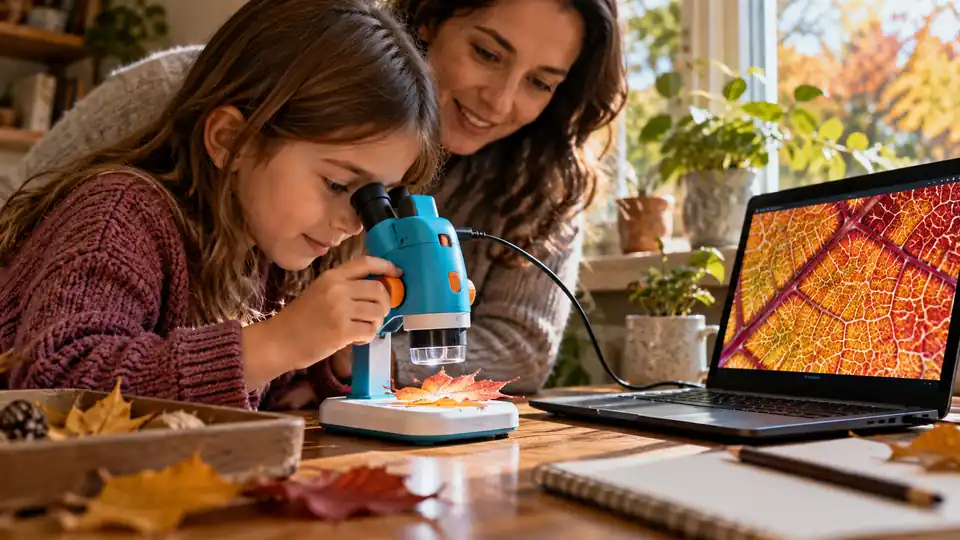
A child can turn a leaf, coin, feather, or scrap of fabric into a small investigation with a digital microscope, but the experience depends heavily on how quickly the device gets from the box to a clear image. Built-in screens, simple focusing controls, adjustable LEDs, and rechargeable batteries matter more for young users than a dramatic magnification number printed on the package. A microscope that produces a huge but difficult-to-focus image may spend more time in a drawer than in the backyard.
The product listings in this category use magnification claims ranging from 500X to 1600X, yet those figures do not establish optical resolution by themselves. Digital zoom can enlarge an image without revealing extra specimen detail, so practical features such as screen size, focus method, lighting, storage, and included slides deserve close attention. A child who wants to examine bugs outdoors may need a lightweight handheld unit, while a student documenting prepared slides may benefit more from a stand, computer connection, or generous built-in storage.
This roundup favors complete, kid-focused microscopes with documented displays, illumination, capture functions, or useful accessories. The Kids Digital Microscope STEM Toy with its prepared glass slides and carrying case is the strongest all-around package, while larger-screen models suit tabletop viewing and simpler autofocus models reduce setup frustration. The best fit depends on whether the microscope will live beside a science notebook, travel in a backpack, or follow muddy discoveries across the garden.
Quick Answer
- Best Overall: Kids Digital Microscope STEM Toy: Complete Science Gift Kit for Ages 4-12 for its glass slides, 32GB card, EVA case, adjustable magnification, and portable format.
- Best Large-Screen Option: 1600X Microscope for Kids, 4K 4.0″ Digital Screen Kids Microscopes with Slides Kit for its 4.0-inch display and three observation modes.
- Best for Outdoor Use: 1000X Digital Handheld Microscope for Kids Portable Outdoor Toys & Gifts for its 2-inch display, built-in storage, adjustable lighting, and stated three-hour battery runtime.
- Best for Younger Children: Kids Microscope, 500X Digital Magnifying Glass, Explore STEM Toy, Purple for its macro autofocus, built-in magnifier, and straightforward handheld design.
Best Digital Microscopes for Kids Comparison Table
| Product | Best For | Display | Advertised Magnification | Lighting | Notable Feature |
|---|---|---|---|---|---|
| Kids Digital Microscope STEM Toy: Complete Science Gift Kit for Ages 4-12 | Complete science kit | Built-in screen | 200X–1000X | Adjustable LED lighting | 32GB card, glass slides, EVA case |
| 1600X Microscope for Kids, 4K 4.0″ Digital Screen Kids Microscopes with Slides Kit | Large-screen viewing | 4.0-inch IPS | Up to 1600X | 6 LEDs, 3 brightness levels | Handheld, stand, and portable modes |
| Odatay 4K 1000X Digital Microscope for Kids with 32G Card | Prepared slides and travel | 2.4-inch screen | 200X–1000X | 8 LEDs, 3 brightness levels | 32GB card, 12 slides, tripod hole |
| 1000X Digital Handheld Microscope for Kids Portable Outdoor Toys & Gifts | Outdoor exploration | 2-inch HD display | 100X–1000X | 8 LEDs, 4 brightness levels | Built-in storage and stated 3-hour runtime |
| Kids Microscope, 500X Digital Magnifying Glass, Explore STEM Toy, Purple | Simple operation | 2-inch IPS | Up to 500X | 8 adjustable LEDs | Macro autofocus and built-in magnifier |
| 4.0″ Microscope for Kids, Handheld Miniscope, 1600X Portable Kids Digital Mini Pocket Microscope | Phone sharing | 4.0-inch IPS | 100X–1600X | 8 adjustable lights | Built-in hotspot |
| OAEBLLE Kids Microscope, 4K 1000X Zoom, 2.4″ Screen | Lightweight portability | 2.4-inch IPS | Up to 1000X | 8 adjustable LEDs | 150g body and internal photo storage |
| Odatay 1000X Digital Kids Microscope Kit with 12 Slides & 2″ Screen | Slide-based activities | 2-inch IPS | 100X–1000X | 8 LED fill lights | 12 slides and storage for up to 500 photos |
| Pozifu 1000X Handheld Digital Microscope for Kids | Compact everyday use | 2.0-inch IPS | 50X–1000X | 8 adjustable LEDs | Protective case and Type-C charging |
These picks separate complete activity kits from compact handheld viewers, so the practical differences become clearer below.
1. Kids Digital Microscope STEM Toy: Complete Science Gift Kit for Ages 4-12 — Best Overall

This is the most complete learning package in the group. The handheld microscope covers an advertised 200X to 1000X range and includes five real glass prepared slides, giving a child something structured to examine before heading outside to inspect leaves, insects, coins, or clothing fibers. The slide viewing slot is described as 3mm wide, and the focus wheel lets beginners move gradually through the available magnification levels rather than relying on a single fixed view.
The included 32GB memory card, custom EVA case, Type-C cable, neck strap, and manual make the kit easier to organize than a bare handheld microscope. A child can keep the slides and viewer together in the case, while the card provides room for photo and video files without immediately requiring an extra purchase. The approximately 2.5-hour stated battery runtime also suits a long afternoon of observations, although advertised magnification still should not be mistaken for confirmed optical resolution.
Pros
- Includes five real glass prepared slides for structured biology activities.
- Includes a 32GB memory card for photo and video storage.
- Comes with a fitted EVA carrying case for the microscope and accessories.
- Offers an advertised 200X–1000X range with a manual focus wheel.
- Lists an approximately 2.5-hour continuous-use battery runtime.
Cons
- The published information does not identify the native sensor resolution.
- Glass slides require more careful handling than the handheld viewer alone.
Choose this package for a child who needs both guided slide activities and open-ended nature observation. A simpler model may be easier for very young users who want immediate macro viewing, but this kit gives older children more material to explore and store between sessions.
To buy this product, click here.
2. 1600X Microscope for Kids, 4K 4.0″ Digital Screen Kids Microscopes with Slides Kit — Best Large-Screen Option

The 4.0-inch IPS screen is the defining feature here. A larger built-in display gives two children a better chance of seeing the same leaf vein or coin mark at once, and it makes tabletop science activities easier to share with a parent or teacher. The product also supports three viewing arrangements: handheld, stand, and portable use, so it can shift between a desk experiment and a quick inspection outside.
The listing combines an advertised magnification range reaching 1600X with 48MP photo capture and 1080P video recording. Those capture figures describe the files or recording modes presented by the listing, not proven optical detail, so the microscope should be viewed as a child-focused digital observation tool rather than a substitute for a compound biological microscope. Six LEDs with three brightness levels provide adjustable illumination, while the stated 90-minute continuous battery runtime is shorter than several smaller alternatives.
Pros
- Provides a documented 4.0-inch IPS screen for shared viewing.
- Supports handheld, stand, and portable observation modes.
- Records 1080P video according to the product information.
- Includes a slides kit for activities that begin indoors.
- Offers six LEDs with three brightness levels.
Cons
- The stated battery runtime is up to 90 minutes, shorter than some competing models.
- The listing does not clearly identify the native sensor resolution behind the 48MP photo claim.
This model fits families who expect several people to watch the screen or who want a more substantial tabletop display. A smaller 2-inch microscope is easier to carry, while the 4.0-inch unit makes shared demonstrations and stand-based viewing more comfortable in a fixed location.
To buy this product, click here.
3. Odatay 4K 1000X Digital Microscope for Kids with 32G Card, Long Distance Viewing & 2.4″ Screen — Best Complete Portable Kit

This Odatay model balances a larger-than-basic 2.4-inch screen with a travel-ready kit. Its advertised 200X to 1000X range includes a lower setting described for longer-distance viewing, which can be useful for looking at larger objects without pressing the lens directly against a specimen. At higher settings, children can investigate nearby surfaces such as coins, plant textures, fabric, and insect details.
The package includes a 32GB TF card, 12 prepared slides, a slide viewing cover, a lanyard, a data cable, and a silicone screen protector. A tripod hole is also listed, giving families an option for more controlled positioning, although the product information does not specify a tripod or stand in the package. Eight LEDs and three brightness levels support indoor and outdoor viewing, while the 0.5-pound weight keeps it manageable for a backpack or classroom bin.
Pros
- Includes 12 prepared slides for immediate guided activities.
- Includes a 32GB TF card for storing captured files.
- Provides a 2.4-inch screen, larger than the 2.0-inch displays in several alternatives.
- Lists a tripod hole for optional steadier positioning.
- Includes eight LEDs with three brightness levels.
Cons
- The listing does not identify the native sensor resolution behind its 4K description.
- The package does not list a tripod, so the tripod hole may require a separate accessory.
This is a useful middle ground for a child who moves between prepared slides, backyard specimens, and travel activities. The larger screen and included card add convenience, while the lack of a supplied tripod makes the more stable viewing option an extra step.
To buy this product, click here.
4. 1000X Digital Handheld Microscope for Kids Portable Outdoor Toys & Gifts — Best for Outdoor Exploration

Outdoor use puts a premium on portability, controls, lighting, and battery life, and this handheld model addresses each of those areas in its product information. It weighs 200g, includes a detachable neck strap, and uses a 2-inch color display rather than an eyepiece. A child can carry it on a nature walk, pause beside a rock or leaf, and view the surface directly on the screen without returning to a desk.
The microscope advertises 100X to 1000X magnification, eight LEDs with four brightness levels, built-in storage for more than 200 photos and AVI videos, and up to three hours of continuous use from its rechargeable 600mAh battery. The anti-glare diffuser and multiple brightness settings are relevant around shiny objects or changing outdoor light, though they do not guarantee that every reflective surface will be free of glare. Files can be transferred to Windows or Mac computers through the included USB-C cable according to the listing.
Pros
- Lists up to three hours of continuous battery use.
- Includes four lighting levels from off through high brightness.
- Stores more than 200 photos and AVI videos internally according to the listing.
- Includes a detachable neck strap for carrying outdoors.
- Provides USB-C file transfer to Windows or Mac computers as described.
Cons
- The 2-inch screen is smaller than the 4.0-inch displays on two selected alternatives.
- The published information does not specify the native sensor resolution.
Pick this one for a child who is likely to inspect leaves, bugs, dirt, and rocks away from a desk. A kit with glass slides is more appropriate for structured indoor lessons, while this model gives outdoor spontaneity and longer stated battery life greater priority.
To buy this product, click here.
5. Kids Microscope, 500X Digital Magnifying Glass, Explore STEM Toy, Purple — Best for Simple Operation

Young children can lose interest quickly if focusing becomes a fiddly chore. This model uses macro autofocus, so the product information says children can bring the rear lens close to a leaf, shell, fabric, or insect and let the device bring the image into view without turning a manual focus wheel. It also includes a built-in traditional magnifier for quick, low-setup looks before switching to the digital display.
The 2-inch IPS screen and eight adjustable LEDs keep the viewing process self-contained, while built-in memory stores up to 200 photos. A compatible microSD or TF card, which is not included, can be added for video recording up to 64GB according to the listing. The 500X advertised maximum is lower than some alternatives, but that number should not be read as a direct measure of image detail. Its real distinction is the simpler observation workflow.
Pros
- Uses macro autofocus instead of requiring a manual focus wheel.
- Includes a traditional magnifier for quick non-digital viewing.
- Provides a 2-inch IPS screen for live observation.
- Includes eight adjustable LEDs for specimen illumination.
- Stores up to 200 photos internally according to the product information.
Cons
- A compatible memory card is required for video recording and is not included.
- The advertised magnification tops out at 500X, below the stated maximums of several alternatives.
This is the sensible pick for a younger child who needs quick results and may find manual focusing frustrating. Older children wanting prepared slides, longer documentation sessions, or more control may prefer one of the manual-focus kits farther up the list.
To buy this product, click here.
6. 4.0″ Microscope for Kids, Handheld Miniscope, 1600X Portable Kids Digital Mini Pocket Microscope — Best for Phone Sharing

The built-in hotspot is the feature that separates this miniscope from the more basic handheld models. The listing describes a way to upload captured photos and videos to a mobile phone for sharing, giving a child a route from backyard discovery to a family message or digital science journal. The product also carries a 4.0-inch IPS screen, so the phone connection supplements the microscope’s own viewing rather than replacing it.
The advertised range runs from 100X to 1600X, and the product information identifies a 2MP CMOS chip with 1920 by 1080 photo and video capture. Eight adjustable lights help illuminate plant veins, bee wings, coin patterns, ladybirds, and fabric fibers. The listing does not identify the hotspot’s supported phone operating systems or wireless range, so families should treat mobile compatibility as a feature to verify before relying on it for a school project.
Pros
- Includes a documented built-in hotspot for mobile sharing.
- Provides a 4.0-inch IPS display for direct viewing.
- Identifies a 2MP CMOS chip and 1920 by 1080 photo and video capture.
- Offers an advertised 100X–1600X magnification range.
- Includes eight adjustable lights for changing specimen conditions.
Cons
- The listing does not specify supported mobile operating systems for the hotspot.
- The published information does not identify battery runtime.
This model suits families who expect a child to share discoveries by phone as often as they view them on the microscope. A conventional USB-connected model may be easier for computer-based schoolwork, while this one emphasizes portable capture and mobile sharing.
To buy this product, click here.
7. OAEBLLE Kids Microscope, 4K 1000X Zoom, 2.4″ Screen, STEM Toy for Ages 4-8 — Best Lightweight Option

At 150g, this is one of the lighter choices in the group, and its compact body is listed at roughly 4.13 by 3.74 by 2.6 inches. That makes it a practical companion for a backpack, camping trip, or walk around the yard, especially for children who may tire of carrying a larger kit. The 2.4-inch IPS display is still larger than the smallest screens in the category.
The microscope stores up to 200 JPG photos without an inserted TF card, while video recording requires a card supporting up to 64GB. Its eight adjustable LEDs, oversized manual focus dial, and Type-C charging keep the controls focused on basic observation. The stated two-hour operating time with the lights on and video recording active is useful for short outings, though the package does not include an adapter and the listing does not identify the native sensor resolution behind its 4K label.
Pros
- Lists a lightweight 150g body for carrying on walks and trips.
- Provides a 2.4-inch IPS screen.
- Stores up to 200 JPG photos without a TF card.
- Includes eight adjustable LEDs and an oversized manual focus dial.
- Lists up to two hours of use with lights and video recording active.
Cons
- A TF card is required for video recording and is not included.
- The charging adapter is not included with the Type-C cable.
This is a good fit for families who value low carrying weight and immediate photo capture over a large accessory bundle. Children who need prepared slides or a carrying case may be better served by the complete kits, while nature walkers may appreciate this model’s compact format.
To buy this product, click here.
8. Odatay 1000X Digital Kids Microscope Kit with 12 Slides & 2″ Screen, Blue — Best for Slide Activities

The attraction here is the set of 12 prepared plastic slides covering plants, vegetables, insects, and animals. That gives a child a ready-made sequence of subjects to compare at a table, which can be easier for a homeschool lesson or first science project than finding specimens outdoors. The 2-inch IPS screen, 100X to 1000X advertised range, and eight LED fill lights keep the device usable as a self-contained handheld viewer.
Storage is generous on paper, with the listing stating room for up to 500 photos, and a Micro SD card can expand the memory for additional files. The microscope can connect to a computer for larger live viewing, but the product information does not identify the computer operating system or the precise USB function. Its lanyard and small-hand design help with carrying, while the lack of a listed case makes it less protected in a crowded backpack than the EVA-case kit.
Pros
- Includes 12 prepared slides across four subject categories.
- Lists built-in storage for up to 500 photos.
- Provides a 2-inch IPS screen with a 2MP 1080P camera.
- Includes eight LED fill lights for low-light viewing.
- Supports computer connection for larger live viewing according to the listing.
Cons
- The Micro SD card for expanded memory is not included.
- The product information does not identify the computer operating systems supported.
Pick this kit for a child whose interest begins with guided slide activities and photo records. The more complete glass-slide kit adds a case and real glass specimens, while this Odatay option provides more prepared subjects at a lower listed price.
To buy this product, click here.
9. Pozifu 1000X Handheld Digital Microscope for Kids, STEM Educational Toys — Best Compact Everyday Option

Pozifu keeps the basic formula compact: a palm-sized body, a 2.0-inch IPS display, 50X to 1000X advertised magnification, and eight adjustable LEDs. The listing also describes a 178-degree wide viewing angle, which may help several children see the screen from different positions, although no independent viewing measurement is provided. A lanyard and protective case add practical carrying support for a device likely to move between a desk, classroom, and backyard.
The microscope records photos and videos, stores up to 200 high-resolution pictures, and connects to a PC through USB according to the product information. A rechargeable 600mAh battery and Type-C charging avoid disposable batteries, while simple buttons and smooth focusing are presented as kid-focused controls. The listing does not identify computer operating systems, battery runtime, or the native sensor resolution, so those details should not drive a purchase decision.
Pros
- Provides an advertised 50X–1000X magnification range.
- Includes a 2.0-inch IPS display and 2MP 1080P camera.
- Offers eight adjustable LEDs for specimen lighting.
- Stores up to 200 photos according to the product information.
- Includes a protective case, lanyard, and Type-C rechargeable power system.
Cons
- The listing does not specify battery runtime.
- The published information does not identify supported computer operating systems.
This model makes sense for families seeking a compact everyday viewer with a protective case and basic capture functions. Children who need a larger screen, prepared slides, or mobile sharing will find clearer reasons to move up to one of the specialized alternatives.
To buy this product, click here.
Buying Guide
Start With The Child’s Main Observation Habit
A child who spends afternoons collecting leaves, pebbles, and insects needs a different format from a student working through prepared slides at a desk. Handheld models such as the outdoor-focused picks put the screen, camera, lights, and specimen in one portable arrangement. Complete kits with slides and cases create a more organized activity, with the materials ready when curiosity strikes at the kitchen table.
Age labels in the product information are useful starting points, but they do not replace supervision or an honest look at the controls. Manual focus can teach patience and give older children more control, while macro autofocus removes one step for younger users. The simpler the first observation, the more likely a child is to keep exploring rather than abandon the device after a blurry image.
Do Not Treat 1000X Or 1600X As A Resolution Score
Advertised magnification describes enlargement, not the amount of genuine specimen detail the camera can resolve. Digital scaling can make a leaf vein fill the screen while adding no new information, and the supplied listings do not provide enough optical data to compare these products by effective resolution. A lower advertised maximum paired with easier focusing may produce a more useful experience for a child than a higher number that requires careful positioning.
For ordinary objects such as coins, fabric, plant surfaces, and insect bodies, low and medium settings can be easier to use because more of the object remains visible. High settings are better treated as a close-up mode for a small area, not as proof that the microscope can replace a compound microscope for cells or bacteria.
Choose The Screen Around The Viewing Situation
A 2.0-inch display keeps the body small and light, which helps on nature walks. A 2.4-inch screen gives a little more room for shared viewing, while a 4.0-inch screen is more comfortable for a parent, sibling, or small group gathered around a desk. Screen size does not establish sensor quality, but it changes how easily children can frame a specimen and share the discovery.
A built-in display also means the child can begin exploring without a separate computer. Computer connections can still help with a science presentation or larger live image, but compatibility details vary and should be checked against the listing. USB, USB-C, and a cable in the package do not automatically establish support for every computer or phone.
Look For Lighting Control, Not A Big LED Count Alone
Most of the selected microscopes include adjustable LEDs, with several listing eight lights and multiple brightness levels. That matters because a dark insect wing and a shiny coin do not respond to light in the same way. Brightness control can help reduce washed-out areas, but it does not guarantee glare-free viewing, and none of these listings establishes a specialized polarizing system.
For outdoor use, a diffuser or several brightness settings can be useful as the child moves between shade and sunlight. For coins, polished objects, and metallic surfaces, changing the angle of the microscope or specimen may matter as much as pressing the brightness button. The goal is a visible surface with enough contrast, rather than the brightest possible image.
Decide Whether A Slide Kit Adds Real Value
Prepared slides give a child a defined starting point. The glass-slide kit offers five real glass specimens, while other models include 12 prepared plastic slides covering plants, insects, animals, or vegetables. Those supplies can turn a microscope into a planned activity instead of an expensive magnifier waiting for someone to find an interesting object.
Slide kits also introduce a handling issue. Glass needs more care than plastic, and young children may need an adult nearby during setup. Families focused on outdoor inspection may get more use from a lanyard, protective case, or longer battery runtime than from prepared slides, so the most elaborate package is not automatically the most suitable.
Storage And Battery Life Shape The Follow-Through
Photo storage encourages children to compare specimens, build a nature journal, or document a class project. Some models store about 200 photos, while the Odatay slide kit lists room for up to 500 and the larger complete kit includes a 32GB card. Video often requires a TF or Micro SD card, so check whether that card is included before planning a recording-heavy project.
Battery claims also vary. The supplied information lists approximately 2.5 hours for the glass-slide kit, up to three hours for the outdoor handheld model, two hours for some compact units, and up to 90 minutes for the 4.0-inch large-screen model. Actual use can vary with lighting and recording, so a charging cable and a practical charging routine are still worth planning for a field trip.
Use Capture Claims Carefully
Several listings use terms such as 4K, 48MP, or 1080P. These labels can refer to image capture, video recording, display presentation, or marketing terminology, and the supplied information does not establish native sensor performance for most models. A saved file with a large pixel count is not automatically evidence of equal optical detail.
For a child’s science journal, the useful question is whether the microscope can save and transfer images in a convenient way. For a formal scientific observation, more information about optics, sensor design, calibration, and specimen preparation would be necessary. These products are best treated as accessible digital viewers for surface exploration and documentation.
Best Digital Microscopes for Kids FAQ
What Can Kids Examine With A Digital Microscope?
These handheld models are suited to opaque everyday objects such as leaves, rocks, coins, fabric, feathers, insects, and dirt. Prepared slides can provide additional structured activities. A high advertised magnification does not prove that a device can resolve bacteria, cells, or other specimens that require a compound optical system.
Is A Higher Magnification Number Better For Children?
Usually, ease of framing and focusing matters more than the largest printed number. Higher digital magnification can show a smaller portion of a specimen and may enlarge existing pixels without adding detail. A child examining a whole leaf or insect may find a lower setting more useful than 1600X.
Should A Child Use Manual Focus Or Autofocus?
Autofocus can reduce setup steps for younger users, as with the 500X macro model in this roundup. Manual focus gives the child more direct control and appears on several higher-magnification handheld units. The better choice depends on whether the priority is immediate viewing or learning how small focus changes affect an image.
Do These Microscopes Need A Computer?
No. Each selected product includes a built-in screen, so basic viewing can happen without a computer. Some models support computer connection, file transfer, or larger live viewing, but the supplied information does not establish identical operating-system compatibility for every product.
Do Digital Microscopes For Kids Need Prepared Slides?
No. Handheld digital microscopes can examine many objects directly, including leaves, insects, coins, and fabric. Prepared slides add a guided activity and make it easier to begin a lesson indoors. Families should check whether the slides are plastic or glass and provide age-appropriate supervision during use.
How Much Storage Is Enough?
For occasional snapshots, internal storage for around 200 photos may be sufficient. Families planning repeated video recording or a long-term science journal may prefer a model with a supplied 32GB card or expandable storage. Video storage requirements can be higher than photo storage, so a card may become useful quickly.
Can A Child Share Microscope Images To A Phone?
The B0D3PFPSQC model specifically lists a built-in hotspot for uploading results to a mobile phone. Other models list USB or USB-C computer connections, but a charging or data port does not automatically confirm direct phone compatibility. Check the product information for the particular device and phone combination before relying on mobile sharing.
Are These Microscopes Suitable For School Science Projects?
They can help children document observations of accessible objects and prepared specimens, especially when the device saves photos or video. The products should not be presented as laboratory replacements, and the published listings do not establish calibrated measurement accuracy, compound-microscope performance, or professional biological resolution.
Final Verdict
The Kids Digital Microscope STEM Toy with its five glass slides, 32GB card, EVA case, adjustable magnification, and approximately 2.5-hour stated runtime offers the broadest starting package for most families. It supports guided indoor activities and portable observation without making the child assemble a separate collection of accessories.
Different priorities point elsewhere. The 4.0-inch B0H3T7XMLH is easier to share around a table, the B0FCBKGG3Q favors outdoor trips and a longer stated battery runtime, and the B0D56Q3BFN reduces focusing effort with macro autofocus. Compare the display, controls, storage, lighting, and included materials against the child’s likely activities, while treating every advertised magnification and high-resolution label with appropriate caution.
